The Mid-Market ABM Playbook: How We Drive Revenue Without an Enterprise Budget
ABM Isn't 'Marketing to a List.' It's a Revenue Strategy.
I'm tired of hearing that effective Account-Based Marketing requires a massive team and an unlimited budget. It’s a pervasive myth, and it’s the single biggest thing holding ambitious mid-market companies back from achieving their true revenue potential. Let me be clear: ABM is not a complex, enterprise-only tactic. When you strip away the noise and the expensive tech platforms, it is a focused revenue strategy. It’s a mindset shift from broadcasting to a wide audience to orchestrating meaningful conversations with the specific accounts that can transform your business. This shift is why a staggering 67% of brands are now using ABM. They understand that precision beats volume every single time. My team re-framed our entire approach around this principle, and it has fundamentally changed how we contribute to the bottom line.
Our entire revenue strategy rests on three principles that we apply with relentless consistency. First, a laser focus on the right accounts. We don't chase every logo in the market; we identify the select few where we can provide the most value and, in turn, generate the most revenue. Second, deep personalization of our message. We don't just insert a company name into an email template. We invest the time to understand the specific challenges, goals, and stakeholders within each target account and craft our outreach to resonate with their reality. Third, a genuine, unbreakable alignment with our sales organization. This is not optional. It is the foundation upon which everything else is built. When your marketing and sales teams operate as a single revenue unit, the results speak for themselves. Companies with strong sales and marketing alignment see 38% higher win rates and a 36% increase in customer retention. This partnership is not a weekly check-in; it’s a shared objective, a shared language, and a shared commitment to winning our target accounts.
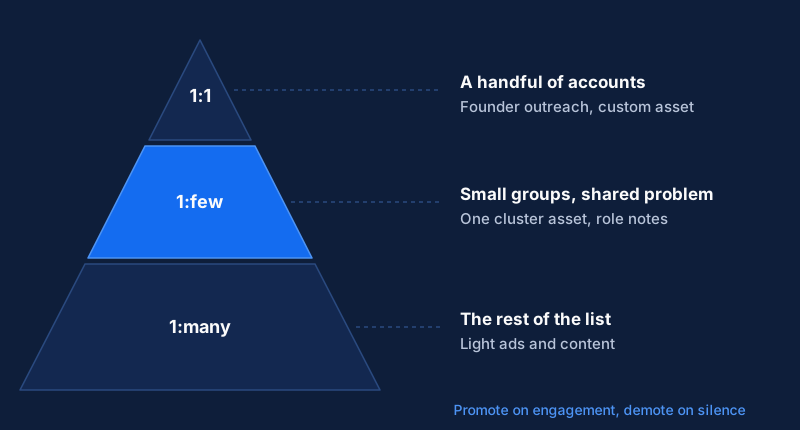
A core part of executing this strategy with a mid-market team and budget is recognizing that we cannot give every target account the same white-glove treatment. That would be a recipe for burnout and bankruptcy. Instead, we use a tiered approach to allocate our finite resources for the greatest possible impact. This isn't a revolutionary concept, but its power lies in its disciplined application. We segment our target account list into three distinct tiers: 1:1, 1:Few, and 1:Many. Our Tier 1 accounts, the crown jewels, receive a truly bespoke, 1:1 experience. These are the accounts with the potential for massive, company-altering deals, and they get our deepest research, most creative outreach, and significant investment from both marketing and sales. Tier 2 is our 1:Few approach, where we group accounts into small clusters based on industry, specific challenges, or technology stack. We then create highly relevant, "cluster-specific" content and campaigns that feel personal without requiring a completely unique build for each logo. Finally, our Tier 3 accounts are engaged through a 1:Many approach, using technology to deliver lighter personalization at scale. This tiered model is the engine of our efficiency, ensuring our most valuable accounts get the attention they deserve while we still engage the broader list in a smart, scalable way.
It is critical to understand that this focused ABM program does not replace our existing demand generation engine. I would never suggest abandoning the broad-based marketing that builds our brand and fills the top of our funnel. Instead, our ABM strategy acts as an accelerator, a high-octane fuel we pour on the fire for our most important accounts. Our demand generation efforts are essential for creating broad market awareness and capturing initial interest. They are the nets we cast wide to see who is swimming in our waters. As accounts engage with our content, visit our website, or interact with our brand, they generate intent signals. These signals are the trigger. We use our broader demand generation work to identify accounts that are demonstrating active interest, and those accounts are then qualified and routed into more focused, resource-intensive ABM plays. It’s a symbiotic relationship: demand generation creates the initial spark, and ABM fans that spark into a flame within our highest-potential accounts.
Stop Guessing: Our Data-Driven Method for Building an Account List
The foundation of any successful ABM program is the Target Account List (TAL). Get this wrong, and every dollar you spend on personalization and execution is wasted. Many teams start and end with their Ideal Customer Profile (ICP), which is a critical mistake. A strong ICP, defining the firmographic characteristics of your best customers (industry, company size, geography), is the starting point, but it's absolutely not the finish line. An ICP tells you who could buy from you; it doesn't tell you who is ready to buy from you. To build a TAL that generates pipeline, we layer our ICP with two other crucial data types: technographics and intent data. Technographic data tells us what technologies an account is using, which helps us identify complementary fits, competitive weaknesses, and integration opportunities. Intent data is the most powerful layer; it shows us which accounts are actively researching our solution category right now. This data-driven approach allows us to stop guessing and focus our expensive resources on the mere 5% of B2B accounts that are actively in-market to buy at any given time.
Many marketing leaders at mid-market companies believe that actionable intent data is out of reach, locked behind enterprise-level contracts with vendors like Bombora or 6sense. While those are powerful platforms, you can build a highly effective intent data practice without that level of spend. My team has developed a hybrid model that works exceptionally well. We start with our own first-party data, which is the most valuable and predictive signal you have. We meticulously track engagement on our website: which accounts are visiting our pricing page? Which are downloading our technical whitepapers? Which are spending time on case studies from their own industry? These are potent buying signals. We then supplement this with more accessible third-party data. This can come from sources like G2, which shows you who is comparing your product against competitors, or from programmatic advertising platforms that can provide topic-level surge data. The modern B2B buyer completes as much as 80% of their journey independently before ever speaking to a sales rep. Intent data, whether it’s first-party or third-party, is our periscope. It allows us to see what’s happening below the surface and join the conversation while we can still shape it.
However, data alone is never enough. The quantitative signals tell us the "what," but they often miss the "why." To bridge this gap and ensure our TAL is grounded in reality, we established a quarterly "Account Scoring Council." This is a mandatory meeting where marketing leadership, sales leadership, and our top-performing account executives come together. In this session, we review the data-generated list of potential target accounts. Marketing presents the quantitative case: the firmographic fit, the technographic profile, the intent signals we're seeing. Then, sales provides the qualitative intelligence. They share on-the-ground insights: "We have a former champion who just joined that company," or "Their main competitor just signed with us, creating a new urgency," or "I heard from a channel partner that their leadership team is frustrated with their current solution." This fusion of quantitative data and qualitative human intelligence is where the magic happens. It validates our data, weeds out false positives, and ensures the final TAL has the enthusiastic buy-in of the people who will be responsible for closing the deals. This collaborative approach is vital; in fact, 74% of companies involve their sales teams in the account selection process to ensure the final list is both accurate and actionable.
Once the Account Scoring Council has ratified the list, the final step is to segment it into the tiers I mentioned earlier. This is not an arbitrary exercise; it is a strategic process that dictates our entire execution plan. The tier of an account determines the level of personalization, the channels we use, the budget we allocate, and the amount of sales time we invest. We have very clear definitions for each tier. Tier 1 is reserved for a very small number of strategic accounts. These are companies that have the potential to deliver a material, needle-moving impact on our company's annual revenue. They get our full 1:1, bespoke treatment. Tier 2 is composed of clusters of accounts that share common attributes, like being in the same vertical, facing the same business challenge, or using the same legacy technology. This allows us to execute 1:Few campaigns that feel highly personalized to their context. Tier 3 is our broadest tier, consisting of good-fit accounts that may be showing early-stage intent. We engage them with a 1:Many approach, using technology and lighter-touch personalization to nurture them until they show signs of escalating interest, at which point they can be promoted to a higher tier. This disciplined segmentation is how we translate a data-driven list into a resource-optimized, revenue-generating strategy.
Executing the ABM Play: How We Engage the Entire Buying Committee
The fundamental shift in an ABM execution model is the goal of the campaign itself. In traditional demand generation, the goal is often to generate a single lead, a Marketing Qualified Lead (MQL), from an individual. In ABM, that goal is completely insufficient. Our primary objective is to build awareness, consensus, and preference within the entire buying committee. Modern B2B purchase decisions are rarely made by one person. They involve a complex web of stakeholders from finance, IT, operations, and leadership, each with their own priorities, concerns, and influence. A single contact, no matter how enthusiastic, cannot drive a complex deal alone. Therefore, our campaigns are designed from the ground up to orchestrate a compelling narrative across the entire account. We map the key personas, understand their individual pain points, and deliver coordinated messaging that addresses each of their needs while reinforcing our core value proposition. This focus on the buying committee is not a "nice to have"; it is the critical factor that separates successful ABM from a series of disconnected, ineffective marketing actions.
Let me walk you through a real campaign we executed for a Tier 2 cluster of accounts in the commercial logistics industry. Our research and intent data showed that several mid-sized freight companies were actively researching fleet management solutions, with a particular spike in searches related to fuel efficiency and cost control. This became the central theme of our 1:Few campaign. We didn't start with a generic demo request. We started with air cover: highly targeted LinkedIn ads served to users with titles like "VP of Operations," "Fleet Manager," and "CFO" at our target companies. The ad creative and copy focused exclusively on the financial impact of rising fuel costs and offered a new guide on "5 Ways to Reduce Fleet Fuel Spend by 15%."
Simultaneously, our sales development team began light social engagement, connecting with these personas and sharing relevant third-party articles on the topic. The centerpiece of the campaign came in week two. We sent a high-impact direct mail piece to the VPs of Operations at each of the ten target accounts. The package wasn't just a brochure; it was a custom-branded box containing a high-quality desk-side perpetual motion device, symbolizing constant efficiency. Included was a one-page letter that didn't sell our product but instead pointed them to a custom-built, interactive ROI calculator on our website. The URL was unique to their company cluster, and the calculator was pre-populated with industry benchmark data for fleet size and fuel costs, allowing them to see potential savings in seconds.
The final, crucial step was the coordinated sales follow-up. Three days after the packages were delivered, our SDRs called and emailed the VPs. Their script was not a cold pitch. It was, "Hi [Name], I'm following up on the perpetual motion device we sent over. Many of our logistics clients are using the ROI calculator to model their potential fuel savings. Were you able to find a moment to plug in your own numbers?" This multi-channel, multi-touch play felt like a single, helpful conversation. The result? We booked meetings with VPs at four of the ten target accounts, a 40% engagement rate that led to a 25% increase in pipeline created compared to our standard benchmark for that segment.
That campaign illustrates how we approach personalization at scale, which is essential for a mid-market team. Creating a fully bespoke, 1:1 campaign for every single target is not a viable option. The key is to find the common ground. In the logistics example, the shared pain point was fuel costs. This allowed us to create a "one-to-few" cornerstone asset, the ROI calculator, that was highly relevant to the entire cluster. Other examples of 1:Few content we create include industry-specific webinar series, case studies that detail the results of a similar company, or benchmark reports that allow a company to see how they stack up against their direct competitors. This approach provides the feeling of deep personalization and relevance that buyers crave, without the unsustainable resource drain of creating purely bespoke assets for every single company on our list. It is the pragmatic path to executing personalized marketing profitably.
Ultimately, effective ABM is an exercise in channel orchestration. It’s the art of making our digital ads, our content, our direct mail, and our sales outreach feel like a single, coherent, and evolving conversation. It’s about ensuring the LinkedIn ad a CFO sees on Monday connects to the email they receive on Wednesday and the call they get from a sales rep on Friday. When we do this correctly, our sales team is never making a truly cold call. They are always following up on warmth that marketing has strategically and methodically created. This tight coordination not only improves the efficiency of our sales team but also drastically improves the buyer experience. The prospect doesn't feel like they are being bombarded by a disjointed company; they feel like they are being guided by a helpful partner who understands their business. This orchestrated approach builds trust and accelerates the entire sales cycle.
The Non-Negotiable Foundation: Forging a Real Sales and Marketing Partnership
I have seen more ABM programs fail because of poor alignment between sales and marketing than because of poor creative, bad data, or a flawed strategy. You can have the best account list and the most compelling campaign in the world, but if your sales team doesn't trust the process, doesn't understand their role, or isn't bought into the goals, your program is destined for mediocrity. A weekly check-in meeting is not alignment. True alignment is structural, operational, and cultural. To codify this, my team and our sales counterparts co-authored what we call a Revenue Operations Agreement. This is our single source of truth. It is a living document that clearly defines the roles and responsibilities for every stage of the ABM process, from account selection to closed-won. It outlines the service-level agreements (SLAs) for follow-up, the specific criteria for escalating an account, and the rules of engagement for every account on our target list. This agreement eliminates ambiguity and creates a system of mutual accountability that is the bedrock of our partnership.
A critical component of this agreement was redefining success. My team's primary success metric is not, and will never again be, Marketing Qualified Leads (MQLs). The MQL is a remnant of a volume-based, lead-centric world that is fundamentally incompatible with an account-based strategy. It incentivizes marketing to generate a high quantity of individual leads, regardless of whether they come from the right accounts or are part of a buying committee. Instead, marketing and sales now share the exact same primary success metrics: pipeline and revenue generated from our Target Account List. This shared goal is transformative. It forces us to think and act as one team. When a campaign succeeds, we all succeed. When a target account stalls, it is a shared problem to solve. This alignment has a direct and profound impact on the business. Research consistently shows that organizations with highly aligned sales and marketing teams achieve 32% higher revenue growth and see up to a 209% increase in marketing-generated revenue. We are living proof of those statistics.
To make this shared accountability work in practice, we maintain a constant, real-time feedback loop. The annual planning session and quarterly reviews are important, but the day-to-day communication is what allows us to be agile and responsive. We built a simple but highly effective communication structure centered around a dedicated Slack channel for each ABM account tier. In these channels, my marketing team shares real-time alerts on significant account engagement. For example, "Heads up: three people from Acme Corp, including the VP of Engineering, are on the pricing page right now," or "New engagement spike: someone from Globex Inc. just downloaded the competitive comparison guide." This gives our sales reps the context they need to time their outreach perfectly. In return, the sales team uses the same channel to share conversational intelligence from the front lines: "Just spoke with the Director at Initech. Their main pain point is integration, not cost," or "The champion at Stark Industries mentioned they are going through a budget freeze until next quarter." This immediate feedback allows my team to adjust our messaging, targeting, and content on the fly, ensuring our strategy is always adapting to the reality of the market.
Finally, we replaced the MQL with a far more intelligent and relevant concept: the Marketing Qualified Account (MQA). This is our official handoff point from marketing to sales, and it's defined with data-driven precision in our Revenue Operations Agreement. An MQA is not triggered by the activity of a single person. It is a threshold of engagement from multiple contacts within the same target account over a specific period. Our MQA model is weighted; a C-level executive visiting the pricing page is scored higher than an intern reading a blog post. We look for a critical mass of engagement, a signal that the account as a whole, not just an individual, is showing genuine buying intent. When an account crosses this MQA threshold, an alert is automatically triggered, and the sales team is obligated, per our agreement, to initiate their intensive outreach sequence within 24 hours. This MQA process ensures that our sales team spends their valuable time on accounts that are truly activated and ready for a serious conversation, dramatically increasing their efficiency and effectiveness.
Beyond Vanity Metrics: How We Prove ABM's Contribution to Revenue
If you want to secure executive buy-in and continued investment for your ABM program, you must speak the language of the business, which is the language of revenue. To do this effectively, you have to completely abandon traditional, top-of-funnel marketing reporting. Metrics like cost-per-lead (CPL) and MQL volume are not just irrelevant in an ABM context; they are actively misleading. They measure activity, not impact. The first thing my team did when we committed to our ABM strategy was to ceremonially retire our old MQL-based dashboard. We replaced it with an account-centric dashboard that is shared with sales, finance, and our executive team. It tracks the metrics that actually matter to the health of the business and clearly demonstrates how marketing's investment is influencing the generation of pipeline and revenue from our most valuable accounts.
Our ABM dashboard is built around four core metrics that tell a complete story of our program's performance. First is Account Engagement. This tracks the depth and breadth of interaction we have with our target accounts over time. We monitor things like the number of engaged contacts within an account, the frequency of website visits, and content consumption. An increase in engagement is our leading indicator of future pipeline. Second is Pipeline Velocity. We measure how quickly our target accounts move through the sales cycle compared to non-target accounts. A successful ABM program should significantly shorten the time from initial contact to closed deal. Third is Average Contract Value (ACV). Because ABM focuses on best-fit, high-potential accounts, we expect to see a higher ACV from our target list. This demonstrates we are not just winning more, but we are winning bigger. Fourth, and most important, is Win Rate. This is the ultimate proof point. We constantly compare the win rate for deals within our TAL against the baseline win rate for all other opportunities. The goal is to show a definitive lift, proving that our focused efforts are creating a competitive advantage. For some companies, this lift can be dramatic, with some enterprise win rates jumping from 25% to 52% after implementing a focused ABM program.
One of the biggest challenges for any B2B marketer is attribution. In a complex sale with multiple stakeholders and dozens of touchpoints over many months, claiming that a single ad or email was "the" reason for a deal is nonsense. The modern B2B buying journey involves an average of 27 touchpoints before a decision is made. So, we don't fixate on perfect, last-touch attribution. Instead, we focus on measuring influence. Our practical model tracks how our marketing campaigns and activities are correlated with an account's progression through the sales cycle. We look for a concentration of marketing touchpoints with key personas within an account just before it moves from one stage to the next. For example, did we see a spike in engagement from the buying committee right before the discovery call was booked? Did the CFO download our ROI guide a week before the deal moved to the proposal stage? Our goal is not to claim sole credit; it is to demonstrate, with data, that our orchestrated marketing efforts are present, active, and influential at every critical stage of the buyer's journey.
When I report on our program to my executive team or the board, the conversation is refreshingly simple and direct. I don't present slide after slide of click-through rates and MQLs. I present a single, powerful financial summary. On one side of the ledger, I show the total, all-in investment in our ABM program for the quarter, including headcount, program spend, and technology costs. On the other side, I show the total pipeline and closed-won revenue generated exclusively from the accounts on our Target Account List. This is the ultimate measure of ROI. It connects marketing's budget directly to the revenue it produces. There is no ambiguity. It is the clearest possible demonstration of our team's value to the business. With 87% of marketers reporting that ABM delivers a higher return on investment than any other type of marketing initiative, this direct connection to revenue is not just how you prove your worth; it's how you make the case for continued and expanded investment in a strategy that truly drives growth.