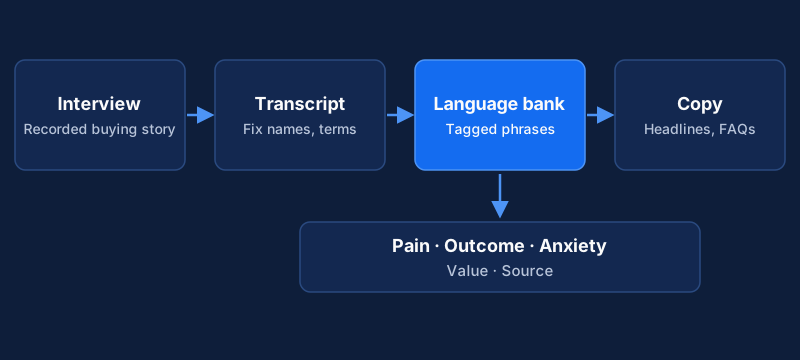
The Message Mining Framework: How We Find the Exact Words Customers Use to Drive Conversions
Stop Guessing: Your Best Messaging Already Exists
I'll start with a hard truth. Most B2B messaging is created in a conference room, completely disconnected from the customer. A group of smart, well-intentioned marketers and executives huddle around a whiteboard, brainstorming words they think will resonate. The result is a sea of sameness. It's generic copy littered with internal jargon, buzzwords, and feature-focused claims that fail to connect with a real human on the other side of the screen. This isn’t just a feeling. One study found that 68% of B2B buyers believe that brands in the same industry all sound the same. When you sound like everyone else, you compete on price, not value.
The core principle my team operates on is that high-performing copy is not written from scratch; it is found. It already exists, waiting to be discovered in the exact, verbatim language your best customers use to describe their problems, their frustrations, and their desired outcomes. This systematic practice of unearthing and applying customer language is known as Voice of the Customer (VoC). It is the single most effective way to create messaging that cuts through the noise because it mirrors the conversation already happening in your buyer’s mind.
This post is not another high-level article about building vague customer personas. I am going to lay out the exact, repeatable framework we use to move beyond personas and systematically uncover real customer language. We call it the Message Mining Framework, and it is the engine that translates raw customer insight into high-converting copy for landing pages, ads, and sales enablement materials. This isn't a "nice-to-have" process for idle teams. The data shows that companies with a mature, customer-centric focus experience 2.5 times the revenue growth of their less-focused competitors.
Over the rest of this article, I will walk you through the five critical steps of our framework. First, we will cover how to conduct the right kind of interviews to get verbatim gold. Second, I will show you how we analyze transcripts to find mission-critical patterns. Third, we will turn those patterns into refined copy. Fourth, you will learn how to benchmark your new messaging against competitors to find your unique position. Finally, I will explain how to validate your work with disciplined testing. This structured approach is how you move your team from expensive guesswork to a data-driven messaging strategy that delivers measurable results.
Step 1: The Interview Frameworks That Uncover Verbatim Gold
The foundation of any effective messaging strategy is qualitative data. Before you can find your customers' language, you have to talk to them. But not all customer conversations are created equal. The quality of your output is entirely dependent on the quality of your input, which means you must be strategic about who you talk to and what you ask.
My team prioritizes interviewing two specific, high-value groups: very recent customers and long-term, successful customers. Recent customers, those who signed up within the last 30 to 90 days, are an absolute goldmine. Their memory of the purchasing journey is perfect. They can recall the specific trigger that started their search, the exact Google terms they used, the competitors they evaluated, and the anxieties they felt right before they committed. Long-term, successful customers provide a different but equally crucial perspective. They have moved beyond the initial problem and can articulate the full spectrum of value they have received. They speak in terms of business outcomes, ROI, and transformation. Interviewing both groups gives you the full story, from the initial pain to the ultimate success, and helps uncover the nuances that quantitative data like surveys and analytics will always miss.
We have completely abandoned traditional product feedback questions in these interviews. Asking "what features do you like?" or "how can we improve?" puts the customer in a problem-solving mindset focused on your solution. We do not want them to think about our product. We want them to talk about their world. To achieve this, we structure our interviews around the 'Jobs to Be Done' (JTBD) timeline. The core idea, popularized by the late Clayton Christensen, is that customers do not just buy products; they "hire" them to do a specific "job." Our entire goal is to understand that job in excruciating detail. We focus our questions on two key moments: the "struggling moment" that prompted their search for a new solution, and their definition of the "after" state, or the promised land they were hoping to reach.
To ensure we get the purest data possible, my team enforces a few practical but strict rules during these interviews. First, we always record the call (with explicit permission, of course). Memory is faulty, and note-taking can introduce bias. We need a perfect, verbatim record. Second, we only ask open-ended questions that prompt storytelling. Our favorite prompts start with "Walk me through..." or "Tell me about the time when..." For example, instead of asking "Why did you buy our product?" we ask, "Walk me through the day you realized your old way of doing things was no longer working." This question unearths the real-world context and emotion behind the purchase. Third, and most importantly, we strictly forbid ourselves from correcting their language. If a customer describes a feature using the "wrong" term, we do not correct them. We adopt their term. Their language is the language that matters, not our internal branding guide. This discipline of active listening not only yields better insights but also builds deeper, more authentic customer relationships.
The goal of this step is not to get a glowing review or a list of feature requests. The goal is to collect a raw, unfiltered transcript of how a customer thinks, feels, and talks about their work, their challenges, and their aspirations. This qualitative data provides the rich, contextual insights into their motivations that you can never get from a dashboard. It is the raw material for messaging that truly connects.
Step 2: Transcription Analysis for Critical Patterns
Raw interview audio is an asset, but it is a useless one until it is processed correctly. A 45-minute recording contains thousands of words, and your job is to systematically distill them into actionable insights. This is where we move from data collection to pattern recognition.
First, we get everything transcribed. We use an AI-powered transcription service like Descript or Sonix to quickly convert the audio files into a baseline text document. These tools are fast and remarkably accurate, but they are not perfect. That is why the next step is a non-negotiable human review pass. A team member listens to the original audio while reading the transcript, correcting any errors in terminology and, more importantly, listening for tone, emotion, and emphasis. A customer might say "it was a nightmare" with a laugh, or they might say it with a heavy sigh. The AI will not catch that nuance, but it is a critical piece of data. That sigh is where the real pain lives.
With clean transcripts in hand, we build our central "Messaging Source of Truth." This is typically a collaborative spreadsheet or an Airtable database, and it becomes our single most valuable marketing asset. This document is the core component of a mature Voice of the Customer (VoC) program, a system where you methodically collect, analyze, and act on customer insights. Each row in our Source of Truth represents a single, powerful quote or phrase from a customer interview. Each column contains metadata about that quote: the customer's name, their company, their role, and the date of the interview.
Next comes the most critical part of the analysis: tagging. We read through every single transcript line by line and tag insightful phrases according to a simple but effective system. Our entire system is built on just five core categories:
- Pains: These are direct descriptions of the customer's struggles, frustrations, and problems before they found our solution. We look for phrases that describe wasted time, costly errors, team friction, or missed opportunities. Example: "I was spending at least 10 hours a week manually reconciling spreadsheet data."
- Desired Outcomes: This is the "after" state. What was the customer hoping to achieve? What does success look like in their words? This is not about features; it is about results. Example: "I just wanted a single report I could trust without having to check three different systems."
- Anxieties: These are the hesitations, doubts, and fears they had during the buying process. What made them pause before signing up? What were they worried about? Example: "I was worried it would be another complex tool that my team would refuse to adopt."
- Value Statements: These are the customer's words for our ROI. How do they describe the specific value they get from our product now that they are a successful customer? Example: "This tool gives me back a full day of work every week, and our data accuracy has never been higher."
- Watering Holes: Where did they go to look for information when they were searching for a solution? We listen for mentions of specific communities, influencers, publications, or review sites. Example: "I asked for recommendations in a private Slack group for RevOps leaders."
This tagging process is meticulous, but it transforms a messy collection of transcripts into a structured, searchable database of customer language. This organized data creates a powerful feedback loop that informs multiple departments. Marketing uses the Pains and Desired Outcomes for ad and landing page copy. The product team studies the Value Statements to understand which features drive the most impact and spots feature gaps. The sales team uses the Anxieties to proactively prepare for and handle common objections. The Messaging Source of Truth becomes a living document, the epicenter of customer intelligence for the entire organization.
Step 3: Language Extraction-Turning Raw Insights into Refined Copy
This is the step where research becomes revenue. We move from methodical analysis to creative assembly, using the "Messaging Source of Truth" as our palette. The goal is to stop inventing copy and start arranging the powerful, resonant language our customers have already given us.
Our primary technique is a "Swipe and Adapt" method. We literally copy and paste the most powerful, recurring, and emotionally charged quotes from our Source of Truth document directly into our copy docs. We are not looking for inspiration; we are looking for the exact words. When multiple customers use the same phrase to describe a pain point, that phrase becomes a leading candidate for a headline. When they articulate a desired outcome with clarity and emotion, that becomes the sub-headline. This practice is not new. One of the most famous examples comes from outside B2B, but the lesson is universal. In 2009, Domino's Pizza was struggling with a reputation for poor quality. Their research uncovered verbatim customer feedback describing their pizza as tasting like "cardboard." Instead of burying this harsh criticism, their marketing team put it front and center in a national campaign acknowledging the problem and promising to do better. The result was a stunning 14.3% jump in same-store sales in the first quarter of 2010. They used the customer's language, and it felt brutally honest and authentic.
Let me give you a clear "before and after" example from our own work. A product manager might describe a feature as "Robust Scheduling Automation." This is technically accurate but emotionally sterile. It is corporate jargon. During our interviews for a project management tool, we found that customers repeatedly said things like, "I just want to get my team on the same page without sending a dozen emails back and forth" and "The constant email chaos was killing our productivity."
- Before (Conference Room Copy): Robust Scheduling Automation
- After (Customer-Led Copy): Get Your Team on the Same Page. Without the Email Chaos.
The "after" version is not just better; it operates on a completely different level. It is more specific, it directly addresses the true pain point (the chaos of email), and it uses the conversational language of the customer. It feels true because it is true.
We also map different types of customer language to different stages of the marketing funnel. Pain-point language is incredibly effective for top-of-funnel assets like social media ads and cold outreach. These messages need to stop the scroll and create immediate recognition. When a prospect reads a headline that perfectly describes their biggest frustration, they feel seen and understood. This is critical in B2B, where 74% of marketers cite lead generation as a top goal achieved through their content. For mid-funnel assets like pricing pages, product pages, and case studies, we shift to using language about Desired Outcomes and Value Statements. Here, the prospect is solution-aware and is actively evaluating options. Our job is to paint a clear picture of the "after" state using the words of their successful peers.
This entire process removes the copywriter’s ego from the equation. The job is no longer about being a clever wordsmith or an inventor of slogans. The copywriter’s job shifts to become that of an arranger or an editor. Their skill is in identifying the most potent pieces of customer language from the research and assembling them into a clear, compelling, and logical narrative. The copy feels authentic to the buyer because it is composed of their own words.
Step 4: Sharpening Your Message with Competitive Analysis
Your messaging does not exist in a vacuum. Your prospects are constantly evaluating you against your competitors, whether you realize it or not. Therefore, understanding the competitive landscape is not just about features and pricing; it is about understanding the language your competitors use and, more importantly, the language they are neglecting.
Our approach to competitive analysis is different from most. We perform a deep analysis of our competitors' customer-facing language, but we intentionally spend very little time on their homepage or their carefully crafted brand guides. That is the message they want to project. We care far more about the message their customers are actually receiving. To find that, we go straight to third-party review sites like G2, Capterra, and TrustRadius. We systematically mine their customer reviews to understand what their customers say about them, both good and bad.
To organize this intelligence, we build a competitive messaging matrix. This is another spreadsheet that tracks each of our top competitors. The columns are structured to give us a multi-dimensional view of their positioning:
- Primary Value Proposition: What is the main promise on their homepage? (e.g., "The All-in-One Platform for Finance Teams")
- Pain Points They Focus On: What problems do they claim to solve in their marketing copy? (e.g., "Stop Wasting Time on Manual Reporting")
- Key Phrases They Own: Are there any specific terms or phrases they use repeatedly? (e.g., "Financial Automation Engine")
- What Their Customers Say (Positive): We fill this column with direct quotes from 4 and 5-star reviews. What do their happiest customers praise? What value do they highlight?
- What Their Customers Say (Negative): This is often the most revealing column. We pull quotes from 1 and 2-star reviews. What are the common complaints? Where does the product fail to deliver on its promise? What frustrations do their customers voice?
This analysis invariably reveals "language gaps" in the market. A language gap is a disconnect between what the category is talking about and what customers actually care about. For example, you might find that every competitor in your space is talking about "powerful integrations" and "seamless workflows." But when you analyze your own customer interviews and your competitors' negative reviews, you might discover that customers are consistently talking about the pain of "reducing manual data entry" and "eliminating copy-paste errors."
This is a massive opportunity. You have found a powerful differentiator. While your competitors are stuck talking about a feature (integrations), you can own the conversation about the outcome that feature is supposed to deliver (reducing manual data entry). You can build your entire messaging strategy around the language your competitors are ignoring. You align your copy directly with the true, unmet need of the market. B2B buyers are looking for value and ROI. By identifying these gaps, you can frame your solution not as a set of features, but as the most direct path to the business outcomes they are trying to achieve, creating a far more compelling case for your product.
Step 5: Validation and Iteration Through A/B Testing
Our customer research provides a set of powerful, well-founded hypotheses about what messaging will work. But a hypothesis is not a conclusion. The final and most critical step in our framework is to validate our customer-led copy with quantitative data. We use A/B testing to prove that the new messaging does not just sound better; it performs better.
We are strategic about what we test. We prioritize testing on high-impact, high-traffic assets first. Changing the copy on an obscure blog post will not have a meaningful business impact. Changing the headline and sub-headline on your homepage hero section, your primary demo request landing page, or your highest-spending ad creative can fundamentally alter your growth trajectory. Despite the proven impact of this practice, the data is surprising. One study found that only about 17% of marketers frequently A/B test their landing pages. This represents a significant competitive advantage for the teams who build this discipline.
Every test we run begins with a clear hypothesis rooted directly in our research. We do not just throw ideas at the wall. A proper hypothesis looks like this: "By replacing our current headline, 'The Future of Financial Reporting,' with the verbatim customer quote, 'Finally, a Financial Report My CEO Can Actually Understand,' we predict a 15% increase in demo signups. We believe this is because the new headline addresses the specific, urgent pain point of communicating complex data to non-financial stakeholders, which our interviews identified as a primary purchase driver." This disciplined approach removes guesswork. It forces us to articulate why we believe a change will work, and it allows us to learn from both our winning and losing tests.
Crucially, this entire framework is a continuous process, not a one-time project. The market changes, your product evolves, and your customers' needs shift. Your messaging must adapt as well. We have built systems to pipe a constant stream of new customer language into our "Messaging Source of Truth." Notes from sales calls are automatically tagged and added. Support ticket conversations are analyzed for recurring pain points. New G2 reviews are scraped and categorized. This creates a durable marketing feedback loop that keeps our messaging perpetually fresh and aligned with the current reality of our customer base.
Ultimately, the Message Mining Framework creates a powerful, virtuous cycle. Customer research informs our copy, and A/B test results validate (or invalidate) our research, which in turn helps us ask better questions in our next round of interviews. For B2B companies, where customer acquisition costs are high and even a small improvement in conversion rate can translate into millions of dollars in new revenue, this systematic approach is essential. It gives us the confidence to know that we are not just guessing. We are building our entire go-to-market strategy on the most stable foundation there is: the voice of the customer.