17 min read

Firmographics Are Dead: The Behavioral Intent Signals We Use to Find Our Best Prospects

Prospecting StrategyData AnalysisLead Scoring

Introduction: The 'Perfect' Account That Ghosted Us

I remember the account perfectly. Let's call them Apex Solutions. On paper, they were our dream prospect. They were in our core industry, hit our sweet spot for annual revenue, and had the exact employee count that signaled a perfect fit for our enterprise package. My team and I looked at their firmographic profile and saw a closed-won deal. We spent the better part of a quarter chasing them. We sent personalized emails. We ran targeted ad campaigns. We had our best SDRs making thoughtful calls. The result was complete, deafening silence. Zero engagement. Not a single returned email, not one click-through, nothing. We were prospecting into a black hole.

Around the same time, an inbound lead came through from a company I’ll call Innovate Dynamics. They were in a vertical we barely touched. Their employee count was smaller than our typical target. By all our traditional measures, they were a C-tier lead at best. My team almost disqualified them. Thirty days later, they signed a contract that beat our quarterly target for that segment.

What was the difference? It had nothing to do with their company profile and everything to do with their actions. Before we ever spoke to Innovate Dynamics, they were all over our digital properties. Multiple people from their domain visited our pricing page. Someone downloaded an integration guide. Another person spent twelve minutes watching a late-stage product demo. They were showing clear, observable buying intent. They were telling us they were in-market before we even knew they existed. This isn't an anomaly. A recent report from 6sense found that 81% of buyers have already chosen a preferred vendor before they make first contact. They are deep into their journey by the time they raise their hand. Innovate Dynamics was on that journey, and Apex Solutions was not.

This experience was a wake-up call. It forced my team to fundamentally re-evaluate our entire prospecting motion. We were spending the majority of our time and resources chasing ghosts, armed with static lists that told us nothing about an account’s current needs. We had to shift from a static, firmographic-first approach to a dynamic, behavior-first strategy. The modern B2B buyer is in control. According to Gartner, buyers spend only about 17% of their total purchase journey time meeting with potential suppliers. That means the other 83% of the time, they are on their own, doing research, reading articles, comparing vendors, and building a shortlist. Our old method was completely blind to that critical 83% of the buying process.

My thesis for this post is direct: Relying on firmographics alone is prospecting with a blindfold on. It’s an outdated model that creates massive inefficiency and burns out your best people. Over the next few thousand words, I am going to show you exactly how we use behavioral signals to identify accounts that are actively in-market, how we interpret their digital body language, and how we engage them at the peak of their interest to dramatically increase our pipeline velocity and win rates.

Why Firmographics Are Just Table Stakes, Not a Targeting Strategy

For years, sales leaders have built their empires on the foundation of the Ideal Customer Profile, or ICP. We define our targets by industry, revenue, employee count, and geographic location. These firmographic and demographic details are comfortable. They are quantifiable. They fit neatly into the rows and columns of a CRM report. And they are absolutely essential for one thing: defining your total addressable market (TAM).

But here’s the hard truth I had to face: firmographics are not a targeting strategy. They are, at best, a starting point. They are the table stakes required to even play the game. They answer the question, 'who could buy our product?' but they tell you absolutely nothing about the far more important question: 'who is buying right now?'

Relying on a firmographic list to guide your daily prospecting is like trying to navigate a city using a map drawn five years ago. The map shows you all the streets, but it doesn't tell you which ones are closed for construction, which have gridlock traffic, or where a major accident just happened. You can see the destination, but you have no real-time information to get there efficiently. This is why, according to some reports, only about 2% of cold calls ever result in a meeting. Your reps are calling companies that could buy, not companies that are buying. The vast majority of your TAM is not in an active buying cycle for your solution at any given moment. They don’t have the budget approved, the project prioritized, or the internal pain acutely felt. They are a dot on your map, but they are not a live opportunity.

The second critical failure of a firmographic-first model is that the data is not just static, it decays with alarming speed. People change jobs, companies get acquired, businesses pivot, and titles are redefined. Research shows that B2B contact data decays at a staggering rate, with estimates ranging from 22.5% to over 70% per year. This means that a list of target accounts you pulled just three months ago could be more than 15% inaccurate. My sales team used to operate from these lists, and the result was predictable. They would spend hours crafting the perfect email for a key contact who had left the company two months prior. They would call into an account to discuss a problem that was solved last quarter. It was a recipe for wasted effort and profound frustration.

This over-reliance creates massive, systemic inefficiency. I watched my A-players, the reps I hired for their strategic thinking and closing ability, burn countless hours on these ‘perfect-fit’ accounts that had absolutely no need or interest in our solution. This directly harmed team morale. Nothing crushes a salesperson’s spirit more than a week of fruitless, zero-response outreach. It also destroyed our pipeline velocity. The time spent chasing cold accounts was time not spent engaging with warm, active ones. We were misallocating our most precious resource: our sellers’ time. We know that salespeople spend only about 28% of their time actually selling; the rest is consumed by administrative tasks, internal meetings, and, in our case, prospecting into stale, unresponsive lists. We were making a bad situation even worse.

Let me offer an analogy that crystallized this for my own team. Firmographics are like buying a fishing license for a specific lake. The license grants you the legal right to fish in that body of water. It tells you the boundaries of the lake and the types of fish you might find there. It defines your TAM. But it gives you zero information about where to cast your line. You could spend all day trolling in empty, barren parts of the lake and go home with nothing.

Behavioral intent data, on the other hand, is the fish finder. It’s the sonar technology that pings the depths and shows you exactly where the schools of fish are congregating right now. It shows you the hot spots. It shows you which fish are active. It doesn't just tell you that you're in the right lake; it tells you precisely where to drop your hook. Our shift was about putting down the paper map and turning on the sonar. It was about giving our sellers a fish finder instead of just a fishing license.

The Behavioral Intent Signals That Actually Predict Deals

Once we committed to moving beyond firmographics, the next step was to define what "good" actually looks like. What are the digital breadcrumbs that lead to a closed deal? We quickly learned to break these signals down into two critical categories: first-party intent and third-party intent.

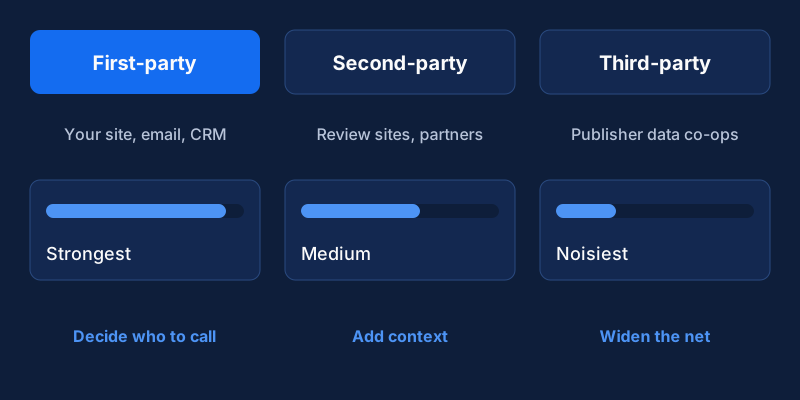
First-party intent data is the information you collect from your own digital properties. This includes your website, your blog, your landing pages, and your marketing automation platform. I will state this unequivocally: your first-party intent data is the single most valuable and predictive asset you have in your revenue arsenal. Its accuracy and relevance are unmatched for one simple reason. It shows direct interest in your solution, not just a general interest in a category. It's the difference between someone reading a magazine about cars and someone walking into your specific dealership.

We obsess over first-party signals. My team has identified a hierarchy of actions that correlate directly with sales-readiness. Here are the specific first-party signals we prioritize above all others:

  • High-Value Page Views: Not all website visits are created equal. A visitor to our homepage is curious. A visitor to our pricing page is evaluating. Someone on our integrations page or a "compare us to Competitor X" page is in a late-stage consideration cycle. These are not passive browsers; they are active shoppers. We treat a visit to the pricing page as a powerful indicator of serious intent.
  • Repeat Visits from Multiple Stakeholders: A single person from an account visiting your site is interesting. Five different people from that same account, including a VP of Engineering and a Director of Finance, visiting your site over the course of a week is a five-alarm fire. This signals the formation of a buying committee and shows the project has internal momentum.
  • Bottom-of-Funnel Content Downloads: Just as with page views, content consumption signals different levels of intent. Someone downloading a top-of-funnel ebook on industry trends is learning. Someone downloading an implementation guide, a technical whitepaper, or using an ROI calculator is planning. They are moving from the "what" and "why" to the "how." These downloads are clear evidence that they are visualizing what it would be like to be our customer.

Focusing on these signals works. Forrester research has shown that organizations that effectively use intent data can see conversion rates increase by up to 3x compared to traditional methods. We are no longer guessing; we are responding to direct digital body language.

Third-party intent data is gathered from across the wider web. It comes from B2B publisher networks, co-op data sources, and technology review sites. This data tracks which companies are consuming content about specific topics, keywords, and competitors across thousands of websites that are not your own. For instance, it can tell you that an account is suddenly surging in research around the topic "cloud data security platforms."

We've found that third-party intent is most powerful when used as an early warning system or a confirmation signal. By itself, it can be noisy. An account showing a surge on a topic like "data analytics platforms" is certainly interesting. It tells us they are likely in an early-stage research phase. But that same account visiting our pricing page a day later? That combination is what turns an interesting signal into an urgent priority. The third-party data provides the broad, early-stage context, and the first-party data provides the specific, high-value validation. We use third-party signals to identify accounts entering the top of the funnel and to prioritize which accounts on our target list we should be watching more closely.

The most important lesson we learned is that you cannot act on a single signal in a vacuum. A single visit to a blog post means very little. The real magic happens when you identify a cluster of signals occurring in a concentrated period. This is the foundation of our entire model. We defined what an "intent-qualified account" (IQA) looks like for our business. It’s not based on a form fill. It’s based on a threshold of specific actions occurring within a short time frame, typically a 7 or 14-day window.

For example, our IQA threshold might be: An account must accumulate 50 "intent points" in 7 days. A pricing page view is 15 points. A demo request is 30 points. A case study download is 10 points. Three different people from the company visiting the site is another 15 points. When an account crosses that 50-point threshold, it is automatically routed to the account owner with a full list of the specific actions that triggered the alert. This isn't a "lead" in the traditional sense. It's a conversation starter backed by a dossier of evidence. And the data backs this up: studies have shown that intent-scored leads are 3.6 times more likely to enter the pipeline. We are focusing our sellers on accounts that are already demonstrating the exact behaviors our best customers exhibited right before they bought.

Content Consumption: Your Strongest Leading Indicator of Buyer Pain

If behavioral intent is the fish finder, then content consumption is the specific species of fish it detects. I make this assertion to my team constantly: what a prospect reads is a direct, unfiltered report on their internal challenges, their priorities, and exactly where they are in their buying journey. We stopped thinking about our content library as a collection of marketing assets. We started treating it like a map of our customers' minds.

This perspective is critical because the modern B2B buying process is driven by self-education. Before ever speaking to a vendor, the average B2B buyer consumes 13 pieces of content. They are reading blog posts, downloading whitepapers, watching webinars, and reviewing case studies to define their problem and identify potential solutions long before they want to talk to a salesperson. Our job is not to interrupt that process, but to understand it and engage at the right moment with the right message.

To do this, we built a clear, actionable system for mapping content to intent. Every single piece of content we produce is tagged with a funnel stage and an intent score. This is not a fuzzy, subjective exercise. It's a core part of our revenue architecture. Here are some clear examples of how we map content:

  • Top of Funnel (Awareness): A blog post titled "5 Key Trends Shaping the Future of Data Analytics" is designed for early-stage awareness. Someone reading this is likely just beginning to explore a new concept. They are defining their pain but are not yet solution-aware. A visit here might earn an account 2 intent points.
  • Middle of Funnel (Consideration): A downloadable whitepaper comparing "The Pros and Cons of On-Premise vs. Cloud Data Warehousing" is for a mid-funnel audience. This prospect understands their problem and is now actively evaluating different approaches to solving it. Downloading this signals a significant step up in seriousness and might earn 15 points.
  • Bottom of Funnel (Decision/Validation): A case study detailing how "Acme Corp Increased Revenue by 25% with Our Platform" is a late-stage validation asset. A prospect consuming this is actively trying to justify a purchase. They are looking for proof and de-risking the decision. This is an incredibly strong signal, reinforced by data showing that case studies are the most influential content format for 42% of buyers. A case study download could be worth 20 points in our model.

This quantitative mapping feeds directly into our lead scoring and account-scoring models. It creates a quantifiable hierarchy of engagement that my sales team can act on with absolute confidence. They are no longer flying blind. When an account hits our IQA threshold, the rep doesn't just see a name. They see a story. They see that someone from the account read a blog post about a specific industry challenge two weeks ago, downloaded a competitive comparison guide last week, and three different people watched a product demo yesterday.

This data allows for hyper-relevant and genuinely helpful outreach. The days of the generic "checking in" email are over. My reps are now empowered to open conversations with incredible context. Instead of, "Hi, I'd like to tell you about our product," the email can now be, "I saw your team was reading our guide on migrating from on-premise systems. Many companies we work with in the logistics space find that the biggest hurdle is data integrity during the transfer. Is that a challenge you're currently navigating?"

This approach aligns perfectly with what buyers want. Research shows this is critical, as 61% of buyers say they select vendors who deliver a mix of content appropriate for each stage of their process. By tracking their content consumption, we are not being intrusive. We are being observant. We are listening to what they are telling us through their actions and using that information to provide value and guide them more effectively through a complex buying decision. We are meeting them exactly where they are.

Timing Is Everything: Using 'Signal Velocity' to Know When to Reach Out

In this new world of prospecting, what a prospect does is only half of the equation. The other, arguably more important, half is when they do it. I introduced the concept of "signal velocity" to my team, and it has fundamentally changed our sense of urgency and prioritization. Signal velocity is the recency and frequency of a prospect's actions. It’s a measure of their momentum. A high raw intent score is good. A high intent score that was accumulated in the last 48 hours is a critical priority that requires immediate action. The velocity tells you how active and urgent their buying cycle is right now.

The data on the importance of speed is almost terrifying. Studies have shown that responding to a lead within the first minute can boost conversions by up to 391%. Waiting just 30 minutes to follow up can decrease your odds of qualifying that lead by 21 times. In a competitive market, the first vendor to provide a helpful response often frames the entire conversation and sets the standard for the evaluation. This is why 78% of B2B customers buy from the vendor that responds to their inquiry first.

Armed with this knowledge, we re-architected our process to prioritize accounts showing a sudden spike in activity. We no longer rely on reps manually checking reports at the end of the day. Our system is built to send real-time Slack and email alerts to account owners the moment a target account exhibits high-velocity behavior. For us, the trigger is typically three or more high-intent actions from an account within a 48-hour window. This could be a pricing page visit, a demo video view, and a case study download all happening in quick succession. When that alert fires, it is an all-hands-on-deck moment for that rep. It's their number one priority.

Another critical timing signal we monitor is the real-time detection of a buying committee. B2B purchasing is not a solo activity. A typical buying committee for a complex B2B solution now involves six to ten decision-makers, and for larger deals, that number can swell to 13 or more. When our systems detect activity from multiple contacts at the same account, especially from different departments (e.g., IT, Finance, Operations), it triggers a high-priority alert. This is our cue that the research phase is escalating into a formal evaluation process.

This is the moment we initiate a multi-threaded sales approach. The assigned Account Executive might reach out to the VP who was looking at an ROI calculator, while their Sales Development Representative connects with the manager who was reading technical documentation. We map our outreach to the known interests of each stakeholder. This approach demonstrates that we understand their organization and respects the complexity of their buying process. It moves us from a single point of contact to a strategic partner in their evaluation.

This focus on timing and velocity has completely transformed our speed-to-lead. The most profound shift is that we are no longer waiting for a form fill. A "Contact Us" form is a lagging indicator. It's the final step a buyer takes after they have already done 80-90% of their research. By the time they fill out that form, they are likely talking to two or three of your competitors as well. Our goal is to engage them before they fill out the form. We want to be part of their research. We aim to connect at the very moment their research and interest are at their peak. By acting on the velocity of their pre-conversion behavior, we give ourselves a significant competitive advantage, entering the conversation earlier and with more context than anyone else.

Building Your Internal Intent Model: A Practical Framework

Shifting from a firmographic to a behavioral intent model is not a simple flip of a switch. It requires technology, alignment, and a commitment to iteration. However, the framework to get started is straightforward. Here is the practical, step-by-step approach we used to build our own internal intent engine.

First, you need the right technology stack. The non-negotiable baseline is a modern CRM and a marketing automation platform (MAP). The specific brand is less important than the core functionality. Your MAP must be able to track on-site user behavior (page views, downloads, time on page) and connect that activity to known contacts and accounts in your CRM. Your CRM is the central nervous system where all this data aggregates and where your scoring models live. Without this foundational tech, you are flying blind. This is also where sales and marketing alignment becomes mandatory. This is not a sales project or a marketing project; it is a revenue project. The data and insights must flow seamlessly between the two teams. When sales and marketing teams are well-aligned, companies see a 208% increase in marketing-generated revenue. The scoring model, the definitions of an IQA, and the handoff process must be co-developed and agreed upon by both leaders.

The second step, and the most crucial one, is to define and score your signals. Do not do this based on guesswork or intuition. Your most powerful predictive insights are already sitting in your CRM. I advise leaders to conduct a "closed-won" analysis. Pull a list of your last 20 or 30 closed-won deals. For each of those accounts, go back and map every single digital touchpoint they had with you before they signed. Which web pages did they visit? What content did they download? How many people were involved? How much time passed between the first touch and the first sales meeting? You will see patterns emerge. You might discover that 80% of your best customers visited the pricing page at least twice and downloaded a specific technical whitepaper. Those actions are the foundation of your predictive model. This historical data tells you what successful buying journeys actually look like.

Third, you must structure a weighted scoring system that reflects the value of these signals. A common mistake is to give firmographic and behavioral signals equal weight. This defeats the entire purpose of the model. Behavioral signals must have significantly more weight because they indicate active interest. A lead who visits your pricing page is signaling more immediate intent than a lead who simply works at a company in your target industry.

Here is a simplified example of how our scoring might look:

Firmographic/Demographic Scores (Static):

  • In ICP Industry: +5 points
  • Title is VP or C-Level: +10 points
  • Company Size is 500-5000 Employees: +5 points

Behavioral/Intent Scores (Dynamic):

  • Visited Pricing Page: +15 points
  • Downloaded a Case Study: +10 points
  • Viewed >75% of a Demo Video: +20 points
  • Requested a Demo/Contact Sales: +50 points (and immediate routing)
  • Repeat visits in 7 days: +10 points

Notice the difference in scale. An account can match our ICP perfectly and only get 20 points. Another account from an "off-target" industry could have three people binge-watching a demo video and viewing the pricing page, easily clearing a 50-point threshold and triggering an alert. This system ensures our reps spend their time on activity, not just attributes.

Finally, you must treat this as a living, breathing system, not a "set it and forget it" project. The market changes, your product evolves, and buyer behavior adapts. We review and refine our intent model every single quarter. We run a regression analysis on all deals won and lost in the previous quarter. We ask critical questions: Which signals were most predictive of our wins? Were there high-scoring accounts that we lost, and why? Did we miss any signals from accounts that we won unexpectedly? Based on these findings, we adjust the point values and the IQA thresholds. Your model must learn and adapt with your business.

This transition requires effort, but the payoff is immense. You move your sales team from a state of high-effort, low-yield cold prospecting to a state of high-efficiency, high-relevance engagement. You empower them to be advisors who show up at the right time with the right information, guided not by a stale list, but by the real-time, digital body language of their future customers.