Scaling Sales: Extract Your Top Reps' Process to 3x New Hire Ramp Time
Introduction: Your Best Sales Process is a Ghost in the Machine
I once managed a seller named Marcus. He was a force of nature. While the rest of the team hovered around 90-110% of their number, Marcus lived in a different stratosphere, consistently hitting 180% or more. In Q3, he closed a deal so large it made the entire company’s year. During the all-hands meeting, our CEO gave him a standing ovation and asked the question on everyone’s mind: “Marcus, how on earth did you do it?”
Marcus just smiled and shrugged. “I just build relationships, you know? Get to the heart of the problem.”
I cornered him later, pressing for details. What questions did he ask? How did he structure his discovery calls? What did his follow-up cadence look like? He tried to explain, but the answers were vague and instinctual. “It’s a feel thing,” he said. The process, the magic, it all lived inside his head. It was brilliant, it was effective, and it was completely unscalable. Marcus was a magician, and when he eventually left for a bigger role, his magic vanished with him.
This is the central problem I see in nine out of ten sales organizations. Your most valuable, revenue-generating processes are undocumented “tribal knowledge.” They exist as a ghost in the machine, a collection of instincts and habits locked away in the minds of your top performers.
Let me be direct: the single biggest inhibitor to predictable revenue growth is process inconsistency. When every seller on your team runs a different play, you are not running a sales organization; you are managing a portfolio of individual sales businesses. Relying on a few superstars like Marcus is a strategy of hope, not a scalable business model. It creates fragility, kills your forecast accuracy, and makes every new hire a high-stakes gamble.
There is a better way. By systematically extracting, documenting, and operationalizing the winning habits of your A-players, my teams have achieved a dramatic and repeatable result: we have cut new hire ramp time from an industry average of 5.7 months down to just 2-3 months. To put that in perspective, research from The Bridge Group shows that SaaS sales ramp times have increased by a staggering 32% since 2020, with nearly half of all B2B tech companies reporting ramp times of five months or longer. We are not just making a marginal improvement; we are creating a fundamental competitive advantage that allows our teams to get to full productivity almost three times faster.
In this post, I will give you the exact method I use to capture this ghost in the machine. We will walk through how to exorcise that tribal knowledge and transform it from a fragile, person-dependent art form into a scalable, data-driven asset. We will cover:
- The massive, hidden costs of running a sales culture on tribal knowledge.
- My step-by-step “Deal Autopsy” method for extracting the winning behaviors from your reps.
- How to structure this intelligence into a dynamic, living playbook, not a static PDF.
- The critical steps for activating the playbook and creating a system of continuous improvement.
This is not a theoretical exercise. This is a practical guide to building a predictable revenue engine.
Why Your 'Tribal Knowledge' Sales Culture Is a Ticking Time Bomb
That feeling of relief when a superstar like Marcus pulls a rabbit out of the hat at the end of the quarter is intoxicating. It’s also a powerful sedative, masking the deep-seated dysfunction that is quietly eroding your business from the inside out. A sales culture built on undocumented expertise is not a culture of elite performance; it is a ticking time bomb. Here are the four primary fuses.
First, there is the high cost of inconsistency. When every representative runs their own unique process, your customer experience becomes a lottery. One prospect gets a world-class, consultative discovery process. The next gets a feature-dump demo. This variability erodes brand trust and creates a chaotic buyer journey. The consequences are severe. Globally, poor customer experiences are estimated to cost businesses up to $3.7 trillion annually in lost revenue. This inconsistency torpedoes your ability to forecast. When you cannot standardize the inputs (the sales activities), you cannot possibly predict the outputs (the revenue). It is no wonder that fewer than half of all sales leaders report having high confidence in their own forecasts. They are not forecasting a process; they are trying to predict the outcomes of a dozen different, conflicting processes running in parallel.
Second, this culture creates a ‘New Hire Black Hole’. Imagine you are a new Account Executive on day one. You are ambitious and eager to start producing. But there is no central source of truth. The "process" is scattered across a dozen different Google Docs, outdated slide decks, and, most critically, the memories of veteran reps who are too busy to help you. You are told to "shadow Sarah" on her calls, but Sarah’s methods directly contradict what "Mark in marketing" told you to do. This fragmented, inefficient onboarding is the direct cause of disastrously long ramp times. Research consistently shows it takes an average of 5.7 months for a new SaaS AE to become fully productive. For over five months, you are funding a full salary and benefits package for an employee who is not yet delivering a positive return. This crushes your unit economics and puts immense pressure on your hiring model. You have to hire well ahead of your revenue plan just to tread water.
Third, you are exposed to extreme ‘Superstar Dependency’ risk. Your business becomes perilously reliant on a few key individuals. What happens when your Marcus gets a better offer and walks out the door? All of that institutional knowledge, every hard-won lesson, and every nuanced sales tactic walks out with him. The cost is not just the recruitment fee to find a replacement. The Society for Human Resource Management (SHRM) estimates that the cost of replacing a mid-level employee is 150% of their annual salary. But for a top-performing seller who holds the keys to the kingdom, the damage is far greater. You lose the revenue they were generating, you risk the customer relationships they personally managed, and you create a crisis of confidence across the rest of the team who looked to that person for guidance. The departure of one individual can derail an entire quarter.
Finally, and most critically for our discussion, a lack of defined process makes meaningful analytics impossible. You cannot measure, analyze, or improve a process that is not defined. Your CRM, which should be your single source of truth for revenue intelligence, becomes a data graveyard. Each rep logs calls differently, defines stages subjectively, and captures information inconsistently. The data is messy, unreliable, and ultimately useless for strategic decision-making. Forecasting becomes a guessing game based on gut feelings rather than a statistical model based on conversion rates through a standardized process. The difference is stark. A study from the Aberdeen Group found that companies with best-in-class, formally defined forecasting processes see 97% of their representatives achieve quota. This compares to just 55% for companies that lack such a structured approach. Without a documented process, you are flying blind, making strategic bets on bad data.
The Extraction Method: How I Mine Your Reps' Brains for Gold
The most valuable intellectual property in your company is not your code or your patents; it is the sum of winning behaviors that your best people execute every single day. The challenge is that this IP is encrypted and stored in their heads. My job is to act as a cryptographer, to break that code and translate it into a language the entire organization can understand. This is not about one-off interviews; it is a systematic extraction process.
The first step is to set the stage correctly. When I schedule these sessions, I make it abundantly clear that this is not a performance review. It is not an interrogation. This is a collaborative effort to codify excellence. My exact language is: “You are one of our top performers, and we need to understand what makes you successful so we can help everyone else on the team win more. We want to bottle your expertise and make it the standard.” This frames the rep as a subject matter expert and a contributor to a strategic project, not a student being tested. Critically, I do not just interview the 200% quota-crushers. I also include solid, consistent mid-tier performers, your "B-players" who reliably hit 100-110% of their number. The A+ players sometimes have outlier habits or an innate charisma that is difficult to teach. The B+ players are often more process-oriented and their successful habits are more transferable to the rest of the team. A blend of both gives you a well-rounded, scalable picture of what works.
With the stage set, I employ my ‘Deal Autopsy’ interview technique. This is a highly structured, Socratic method of walking a representative through a recent closed-won deal. I do not ask broad questions like “How did you win?” I start at the very beginning and move chronologically, forcing them to reconstruct the entire sales cycle from memory and, more importantly, from the artifacts in their CRM and inbox. The goal is to get to an almost painful level of granularity. My questions sound like this:
- “Let’s start at the very beginning. Show me the lead record. Where did it come from?”
- “What was the exact subject line of your first email to the prospect? Let’s pull it up.”
- “Walk me through your prep for the first discovery call. What did you look up on their LinkedIn? What was your hypothesis going into the call?”
- “During that call, what was the one question you asked that made the champion reveal the true budget and timeline? Show me the note you took in the CRM right after you heard it.”
- “Let’s look at the calendar invite for the demo. Who was on it? Why did you invite them? What was in the agenda?”
- “When they raised the objection about our key competitor, what were the precise words you used to respond?”
- “Show me the follow-up email you sent after the demo. What attachments did you include? Why those specific ones?”
This forensic approach forces the rep to move past the generic "I built a good relationship" and recall the specific actions, questions, and phrases that moved the deal forward. And that brings me to the most critical, non-negotiable rule of the extraction process.
Human memory is fallible; recordings are truth. I insist that all customer-facing meetings, especially discovery calls and demonstrations, must be recorded using a conversation intelligence platform. Tools like Gong or Chorus are not optional nice-to-haves; they are the foundation of this entire methodology. These platforms do more than just record audio. They use AI to transcribe and analyze the entire conversation, identifying key topics, talk patterns, customer sentiment, and question-asking frequency. They turn unstructured dialogue into structured, searchable data. The Deal Autopsy interview is powerful, but when I can pair the rep’s recollection with an objective, time-stamped transcript and recording of the actual call, that is where the gold is found. I can see exactly how long the rep spoke versus the customer, which competitor names were mentioned, and the precise moment the customer’s sentiment shifted.
The final step is synthesis. My team takes the raw material from these interviews: the call recordings, the CRM data, the email chains, and the interview notes. We do this for multiple reps across multiple closed-won deals. Then, we lay it all out and begin to look for patterns. We map the sequence of events. We find that 80% of our successful deals involved sending a specific case study after the first call. We discover that top reps ask a variation of the same three "pain-uncovering" questions in every discovery call. We use the conversation intelligence data to identify that deals are 50% more likely to close when the prospect says the phrase "that's exactly our problem" on the first call. This is the alchemy. This is where individual, instinctual actions from your top performers are identified, validated with data, and synthesized into a repeatable process that can be taught to everyone else. We are building a blueprint for success, reverse-engineered from actual success.
Structuring the Playbook: From Raw Notes to a Scalable Asset
The most dangerous moment in this entire process is after the extraction. You have pages of notes, hours of recordings, and a wealth of insights. The temptation is to compile it all into a single, comprehensive document: The Official Sales Playbook. This is a fatal error. A 100-page, static PDF playbook is a monument to good intentions and a completely useless asset. It gets emailed to the team, saved to a shared drive, and is never looked at again. A playbook on a shelf is a paperweight.
My teams build dynamic, digital playbooks that are designed to be used, not just read. They are modular, integrated directly with the tools our sellers use every day, and designed to evolve with real-time performance metrics. The goal is not to create an encyclopedia of sales knowledge; it is to provide the right guidance to the right rep at the right moment.
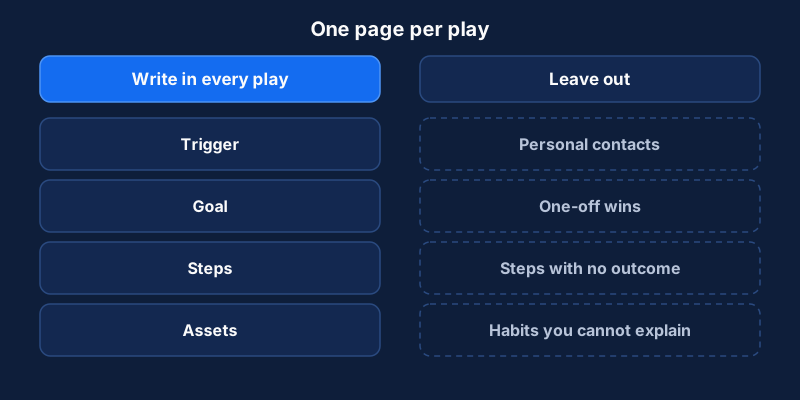
To do this, we structure our playbooks not as chapters in a book, but as a collection of individual, situational "plays." Each play is a specific set of instructions for handling a common scenario in the sales cycle. Every functional play has four essential components, which I call the TOSA framework:
- Trigger: The specific event or signal that indicates this play should be run. It must be an objective, observable event. Example: A prospect mentions a specific competitor by name on a discovery call.
- Objective: The clear, desired outcome of running the play. What are we trying to achieve? Example: Successfully differentiate our solution by highlighting our superior integration capabilities and de-positioning the competitor's closed ecosystem.
- Steps: The sequence of specific actions the rep needs to take. This should be a checklist, not a paragraph. It includes what to say and what to do. Example: 1. Acknowledge and validate the competitor: "They're a great company." 2. Ask discovery question X: "When you looked at their solution, how did they say they handle data import from your ERP system?" 3. Share case study Y, which highlights a customer who switched from that competitor. 4. Use talking point Z to explain our API advantage.
- Assets: The specific pieces of content or tools required to execute the play. Example: Link to the competitor battlecard, the specific PDF of case study Y, a one-pager on our API advantages.
This modular structure makes the playbook digestible and actionable. Instead of having to remember a massive process, a rep just needs to learn how to identify a trigger and execute a 4-step play.
Next, we stress the importance of visual process mapping. The human brain processes images 60,000 times faster than text. A flowchart or a decision tree is infinitely more valuable than a block of prose for explaining a complex process. We use tools like Miro or Lucidchart to create a visual map of the entire sales journey. This map shows the key stages, the exit criteria for each stage, and which plays are most relevant at each point. A new hire can look at this single visual asset and immediately understand the flow of a deal from lead to close. It provides a mental model that is impossible to glean from a text document.
Finally, and most importantly, the documentation must live where your sellers work: the CRM. A playbook in another tab is a playbook that does not get used. We translate the documented process and the individual plays directly into the CRM, which for most of our clients is Salesforce or HubSpot. This is not just about linking to documents. This is about building the process into the workflow.
- We use stage-gate criteria. A rep cannot move an opportunity from "Discovery" to "Solutioning" without filling in required fields for Budget, Authority, Need, and Timeline that were uncovered using our discovery play.
- We create automated task creation. When an opportunity enters the "Proposal" stage, the CRM automatically creates tasks for the rep to schedule a legal review and confirm the decision-making process with the champion, as dictated by our proposal play.
- We embed contextual guidance. Using CRM-native tools, we can display the key steps and required assets for a specific play directly on the opportunity record page, based on the deal stage or other data points.
By integrating the playbook directly into the CRM, we are not just providing guidance; we are building guardrails that make the desired process the path of least resistance. This operational rigor has a direct impact on productivity. Studies have shown that integrating playbooks and content directly into the CRM can reduce the time reps spend searching for the right information by up to 15%. That is time they can now spend selling.
Activation and Iteration: Making the Playbook a Living System
Creating a brilliant, well-structured playbook is only half the battle. A flawless plan with zero adoption is a failure. The final, critical phase of my work is focused on activation and iteration, ensuring the playbook becomes the central nervous system of the sales organization. This requires a deliberate, multi-pronged approach that goes far beyond a simple launch announcement.
First, the rollout is not an email. A project of this importance cannot be launched with a memo. We enforce adoption through a formal certification process. After the initial training on the new process and plays, every single representative, from the newest hire to the most tenured veteran, must be certified. This involves live role-playing of key scenarios. A rep must demonstrate their ability to execute the "Competitor Mention" play, the "Budget Objection" play, and the "Uncovering Pain" discovery play. They are evaluated by their manager and a member of my team against a standardized scorecard. They either pass and are certified, or they receive coaching and try again. This process creates accountability, ensures the new concepts are actually internalized, and sends a powerful message from leadership: this is not optional. This is the new standard of performance.
The linchpins of this entire system are the front-line sales managers. If your managers are not bought in and equipped to coach to the playbook, it will fail. I cannot state this more forcefully. We run dedicated training sessions exclusively for the managers, teaching them how to use the playbook as the foundation for their most important activities: their weekly 1:1s, their pipeline reviews, and their call coaching sessions. In a pipeline review, the conversation shifts from "What's your gut feeling on this deal?" to "I see this deal is in the proposal stage. Did you execute the 'Confirming Decision Criteria' play? Let's review the CRM fields to see what the champion said." In a call coaching session, a manager can pull up a Gong recording and score it against the discovery call checklist from the playbook. Sales managers are the backbone of the commercial model, and they are the key to ensuring that the technology and processes we have built are actually adopted and reinforced every single day.
Of course, to manage the process, you must measure the process. This is where we bring it all back to analytics. I work with sales operations to build a set of dashboards in the CRM that track both adoption and impact.
- Adoption Metrics (Leading Indicators): We track what percentage of opportunities have the required stage-gate fields completed. We measure the usage of specific playbook assets. We can even work with conversation intelligence tools to track how often key phrases from our plays are mentioned on calls.
- Impact Metrics (Lagging Indicators): This is where the value proposition becomes undeniable. We build reports that correlate playbook adherence with key performance indicators. We can definitively show that reps who consistently follow the discovery process have a 20% higher win rate. We can prove that deals where the "Executive Summary" email play was used have a 15-day shorter sales cycle. We can demonstrate that adherence to the negotiation playbook leads to a 5% higher average deal size. The data tells the story: follow the process, win more. This is how you get buy-in from even the most skeptical veteran reps.
Finally, the playbook is never ‘done’. The market changes, your product evolves, and your competitors adapt. A playbook that is not updated is a playbook that is dying. We conclude every engagement by implementing a mandatory quarterly review process. This is a formal meeting with sales leadership, top-performing reps, and product marketing. We use win/loss analysis from closed deals in the past quarter to understand why we are winning and losing. We review the playbook analytics dashboards to see which plays are working and which are not. We gather feedback from the team on what is confusing or outdated. Based on this data, we make concrete decisions: we retire underperforming plays, we refine existing ones, and we create new plays to address new market realities. This turns the playbook from a static document into a living system, a dynamic asset that continuously learns and improves, ensuring the documented process never becomes stale and your team maintains its competitive edge.