My 8x Content ROI Framework: The B2B Distribution System We Use to Dominate Niches
The Great B2B Content Lie: More Creation Is Not the Answer
I’m going to start with a problem I see in nine out of ten B2B marketing departments. It is a quiet, expensive obsession with the content creation assembly line. You can hear the hum of the machine: the keyword research reports being filed, the writer briefs being assigned, the design tickets being completed. The focus is always on the next asset, the next deliverable, the next box to check. This relentless pursuit of more comes at a staggering cost, and it’s not just financial. It’s the cost of wasted opportunity.
The data on this is damning. According to Forrester, as much as 65% of B2B content created by marketing goes completely unused by the sales teams it’s meant to empower. Think about that. Marketing teams are spending weeks and thousands of dollars on a single asset that gets one perfunctory social media post, a mention in a newsletter, and then dies a quiet death in a resource center. It’s a digital ghost town littered with expensive, unvisited assets.
To break this cycle, you must first embrace a critical distinction. You need to separate your content into two distinct categories: Core Content and Distribution Content.
Core Content is your pillar, your foundational asset. This is the high-investment, deep-research piece that establishes your authority on a subject. It’s the proprietary industry report, the comprehensive webinar with an expert panel, or the ultimate guide that becomes the definitive resource on a topic. It is difficult, time-consuming, and expensive to produce.
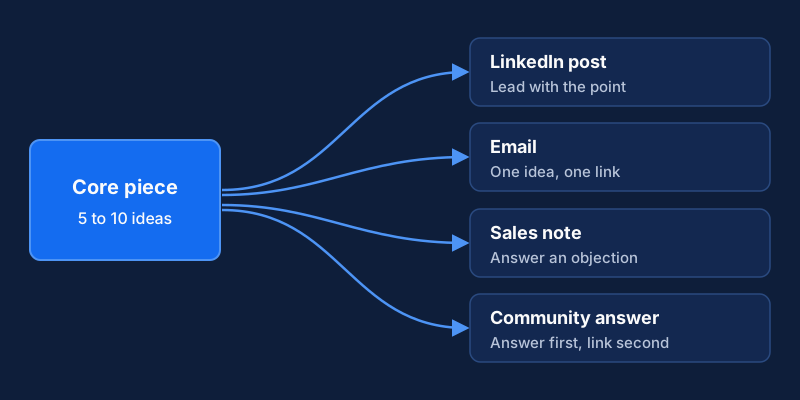
Distribution Content, on the other hand, represents the dozens of smaller, derivative assets we extract from that core. This is not about copy-pasting an executive summary onto LinkedIn. It is about the intentional, strategic act of deconstructing a core idea and redesigning it for different formats, platforms, and audiences. It is the atomic level of your big idea, re-engineered for mass consumption and engagement.
Let’s examine the economic case, because this is where the assembly line mentality truly falls apart. A single, high-quality B2B white paper can easily cost between $5,500 and $7,000, with more complex research-driven projects exceeding $10,000. When marketing leaders treat the publication of this expensive asset as the finish line, they are setting a pile of cash on fire. I argue that the real work, the work that generates ROI, begins after you hit publish on the core asset.
In the remainder of this post, I will lay out the exact system my team uses to multiply the value of every single piece of Core Content we create. This is not a theoretical framework. This is our operational blueprint for turning one major asset into a content engine that supports consistent, high-quality lead generation for an entire quarter. This is how you stop feeding the content monster and start building a strategic content machine.
Our Blueprint: The Hub-and-Spoke Content Model in Practice
The framework that underpins our entire distribution strategy is the Hub-and-Spoke model. It’s a concept many marketers are familiar with in theory, but very few execute with the rigor required to see its full potential.
From my perspective, the Hub is your Core Content. It’s that major research report, that data-heavy webinar, or that definitive guide. These asset types are not chosen by accident. They represent some of the most influential content for B2B buyers who are deep in the consideration phase of their journey. The Hub is the center of gravity for your campaign. It’s the source of truth and the ultimate destination for your most qualified prospects.
The Spokes are the 20 to 50 derivative pieces of Distribution Content we create to amplify the Hub’s central message. Each Spoke is a pathway, an on-ramp designed to capture a specific segment of your audience on a specific channel and guide them back toward the Hub. These Spokes are what drive the qualified traffic and ensure your core insights are not just published but are actually consumed.
Let me give you a concrete, real-world example of how we implemented this.
Last year, our Hub was a major research initiative titled: 'The 2025 State of Enterprise Cloud Security Report.' This was a significant investment. We surveyed 500 CISOs and IT security leaders, analyzed the data with our internal experts, and produced a 40-page, beautifully designed report.
Instead of just publishing it and moving on, we began the atomization process. Our first step was to identify the three most compelling, story-rich themes from the raw data. These became the pillars for our distribution campaign:
- The Rise of AI-Driven Threats: The data showed a significant gap between awareness of new AI-powered cyberattacks and organizational preparedness.
- The CISO's Evolving Role in Procurement: Our research highlighted a shift, with CISOs becoming more influential in budget allocation and vendor consolidation.
- The Measurable ROI of Platform Consolidation: We found a strong correlation between companies using a single, unified security platform and a lower total cost of ownership.
With these themes defined, we built out an entire ecosystem of Spokes from that single Hub asset. Here is a partial list of what we created:
- Three Deep-Dive Blog Posts: Each post was a 1,500-word exploration of one of the core themes, complete with charts and quotes from the report. For example: "Are You Prepared? Why 78% of CISOs Fear AI-Driven Cyberattacks."
- A 12-Post LinkedIn Campaign: We created a series of data-point graphics, each pulling a single, powerful statistic from the report. These were not just links. Each post was a mini-narrative built around that stat, designed to spark discussion in the comments.
- A Summary Infographic: We designed a long-form infographic visualizing the report's top 10 most critical findings. This served as a fantastic, shareable mid-funnel asset.
- A 10-Post X (Twitter) Thread: We broke down the executive summary of the report into a bite-sized, sequential thread. Each post featured a key stat or a graph, guiding users through a compelling story native to the platform.
- A Short Video Interview: We sat down with our lead analyst who spearheaded the research and filmed a 5-minute Q&A. He discussed the three most surprising findings from the report. This video was used on YouTube, our website, and, most importantly, was given to our sales team as a powerful tool for their outreach.
- A Sales Enablement Deck: We created a 10-slide presentation for the sales team, arming them with the report's most potent statistics to use in their conversations with prospects.
- A Nurture Email Sequence: We built a three-part email series for new leads who downloaded the report. Each email focused on one of the core themes, offering additional insight and linking back to the relevant deep-dive blog post.
This model fundamentally shifts your team’s entire operational mindset. You move from a reactive, "launch and forget" mentality to a proactive, "create once, distribute for a quarter" campaign-based approach. It ensures your most valuable insights reach your target buyers wherever they are. This is absolutely critical when you consider that 65% of B2B technology buyers require at least four pieces of content to even shortlist a vendor. Our Hub-and-Spoke model doesn't just provide those four pieces. It provides a dozen, all reinforcing the same core message and establishing our undeniable authority in the market.
Channel-Specific Adaptation: Why Cross-Posting Kills Your ROI
The most common and destructive mistake I see in B2B content distribution is lazy cross-posting. A marketer takes the link to their new blog post, writes a single sentence of copy, and pastes that exact same message across LinkedIn, X (Twitter), and any other channel they can find. This approach is the digital equivalent of shouting the same generic message into a dozen different rooms, each with its own unique culture and language. It respects no one and engages no one.
With 84% of B2B executives using social media to make purchasing decisions, this failure to adapt your message to the platform is a catastrophic waste of opportunity. Each social network has a distinct context, a unique user intent, and an algorithm that rewards specific types of content. Treating them as a monolith is a surefire way to kill your engagement and, ultimately, your ROI.
Our system is built on the principle of channel-specific adaptation. We don't just share content; we redesign it for native consumption on each platform. Here is exactly how we do it.
Our Strategy for LinkedIn:
LinkedIn is the premier B2B social network, but it is not a dumping ground for links. The algorithm actively suppresses posts that immediately try to drive users off-platform. We never just post a link to our Hub asset in the main body of the post.
Instead, our process is narrative-driven. We pull a single, provocative statistic or insight from our Core Content. For our Cloud Security report, a winning post started like this:
78% of CISOs we surveyed believe their current security tools are not equipped for the next wave of AI-powered cyber threats.
Let that sink in. Nearly 4 out of 5 security leaders are looking at their multi-million dollar tech stack and admitting it has a blind spot.
This isn't a problem for 2028. It's happening now. We're seeing threat actors use AI to...
We build a text-only story around that single data point, providing context and stoking conversation. The post is designed to be a complete, valuable piece of content on its own. The call to action is always a question to encourage comments. Then, and only then, do we drop the link to the full report in the very first comment. This strategy respects the user's desire for native content and works with the platform's algorithm, dramatically increasing the post's initial reach and engagement.
Our Process for X (Twitter):
X is a platform for sequential storytelling and rapid-fire information consumption. A single link with a headline is invisible. Our approach is to deconstruct the Hub’s key findings into a compelling 8-to-12-part thread.
The first post in the thread is the hook. It presents the most shocking statistic or the core problem the report solves. Each subsequent post builds on the last, using a clear numbering format (e.g., 1/10, 2/10) to guide the reader. We embed a different chart, graph, or quote graphic from the Hub into each post, making the thread visually engaging and easy to scan. The final post in the thread summarizes the key takeaways and provides the link to the full, gated report. This transforms a passive announcement into an interactive, educational experience that pulls the reader through a complete narrative.
Our Email and Sales Enablement Strategy:
Email remains a powerhouse in B2B, but it requires a thoughtful, long-term approach, especially given the long sales cycles inherent in enterprise deals. We never just send one email announcing the new report. We create a dedicated nurture sequence that highlights one chapter or theme at a time. Week one, the email might focus on AI-driven threats. Week two, it discusses the CISO's role in procurement. This strategy does two things: it educates prospects over a period of weeks, building trust and authority, and it drives repeat traffic back to our ecosystem of content, increasing the number of touchpoints.
Simultaneously, we operationalize sales enablement. It's not enough to hope sales finds your content. You have to arm them with it. Organizations that implement a formal sales enablement strategy achieve a 49% higher win rate on their forecasted deals. For every Hub we produce, we create a dedicated sales enablement kit. This includes:
- A one-page summary with key stats and talking points.
- A pre-written email template reps can use to share the report with prospects.
- A slide deck with the report's best charts and graphs that can be dropped into a sales presentation.
- Answers to frequently asked questions a prospect might have after reading the report.
This turns our content from a passive marketing asset into an active selling tool, directly connecting our efforts to revenue generation.
The Accountability Layer: How We Measure Real Content ROI
As a marketing leader, if your content reporting focuses on page views, likes, and shares, you are failing to speak the language of the C-suite. Vanity metrics are a distraction. The metrics that truly matter are the ones that connect your content efforts directly to business outcomes: pipeline influence, qualified lead generation, and accelerating the sales cycle.
Your CEO does not care about your viral LinkedIn post. They care about how that post generated three demo requests from your target enterprise accounts. This is the accountability layer that must be built into any serious content program. The good news is that the industry is slowly starting to catch on. The Content Marketing Institute's 2024 report shows that 58% of B2B marketers now say their content marketing has helped generate sales and revenue, a significant increase from 42% the previous year. The key is having a system to prove it.
Here’s how we measure the entire Hub-and-Spoke ecosystem.
Measuring the Hub's Success:
The Hub, as our gated Core Content, has the most direct measurement framework. We track several key performance indicators:
- Form Fills / Downloads: This is the top-of-the-funnel metric. How many people were willing to exchange their contact information for the asset?
- Marketing Qualified Leads (MQLs): Of those downloads, how many fit our ideal customer profile (ICP) based on company size, industry, and job title? This is a crucial quality filter.
- Sales Qualified Leads (SQLs) and Opportunities: How many of those MQLs were accepted by the sales team and converted into active sales opportunities in our pipeline?
- Pipeline Influence: Using our CRM, we track which closed-won deals engaged with the Hub at any point in their buyer journey. This allows us to attribute a specific dollar amount of revenue influenced by that single asset.
Measuring the Spokes' Performance:
Measuring the impact of the derivative Spokes is more nuanced but equally important. This is where we track the effectiveness of our distribution channels.
- UTM Parameters are Non-Negotiable: Every single link in every Spoke asset (social posts, emails, guest posts) is tagged with a unique UTM code. This allows us to meticulously track which specific tweet, LinkedIn update, or email drove clicks and, more importantly, subsequent conversions on the Hub's landing page. We can see, for example, that our X thread generated 500 clicks and 15 MQLs, while a specific LinkedIn post from our CEO generated 200 clicks but 25 MQLs, indicating a higher quality audience.
- Beyond Engagement Rates: For on-platform content like LinkedIn posts, we monitor engagement rates (likes, comments, shares), but we go a level deeper. We analyze the quality of that engagement. We manually review the comments and look at the job titles and companies of the people engaging. Ten comments from VPs of Security at Fortune 500 companies are infinitely more valuable than 100 likes from students and consultants. This qualitative analysis tells us if our message is resonating with our true ICP.
The All-Important Feedback Loop:
This detailed measurement creates a powerful, data-driven feedback loop that makes our entire content strategy smarter over time. The performance of individual Spokes tells us precisely what our audience cares about most right now.
Let's go back to our Cloud Security report example. We discovered that the Spokes related to "The ROI of Platform Consolidation" consistently received three times the engagement and generated twice the MQLs compared to the Spokes about "AI-Driven Threats."
What did this data tell us? It told us that while AI threats are an interesting topic, the most pressing pain point for our audience was budget optimization and vendor management. They were under pressure to do more with less. This insight was gold. We immediately used it to inform our next webinar topic, which we titled "The CISO's Playbook for Vendor Consolidation." That webinar had the highest registration and attendance rates of the year.
This is what an accountable system looks like. It’s not just about proving ROI. It’s about using performance data to create a self-improving engine that delivers increasingly relevant and effective content to your audience.
Building the Machine: Our Tools and Workflows for Scale
A strategy of this complexity does not happen by accident. High-volume, high-quality content distribution is a machine, and like any machine, it requires a documented process and the right set of tools to operate efficiently. With 76% of B2B organizations now having a dedicated content marketer or team, a structured workflow is the only way to scale output and impact without exponentially scaling headcount.
Many leaders believe this level of execution requires an expensive, complicated marketing technology stack. It doesn't. Our system is powered by a simple, integrated set of tools that prioritize process over features.
- Project Management (Trello): This is the central nervous system of our content machine. When a Hub is finalized, a new Trello board is created for the distribution campaign. We have columns for "Spoke Ideas," "Drafting," "Design," "Scheduled," and "Live." Every single derivative asset, from a LinkedIn post to a blog, gets its own card. This provides total visibility and ensures nothing falls through the cracks.
- Marketing Automation (HubSpot): HubSpot is where we manage our landing pages, forms, and email nurture sequences. Its real power comes from its CRM integration, which allows us to track every touchpoint and build the attribution reports that prove our ROI.
- Social Media Scheduling (Agorapulse): A robust scheduler is essential for consistency. We use it to queue up our dozens of social media Spokes across multiple channels and profiles, ensuring a steady drumbeat of content without requiring a team member to be manually posting all day.
- Rapid Design (Canva): Our content team is not staffed with graphic designers. Canva allows our content marketers to quickly and easily create high-quality visuals for social media, blog posts, and presentations using pre-approved brand templates. This massively accelerates our ability to turn the Hub's data and insights into visually appealing Spokes.
The technology is the easy part. The most critical component is the workflow that the technology enables. The centerpiece of our workflow is the "Content Atomization Checklist." The moment a Hub asset is finalized, our content manager runs through this checklist. It’s a series of prompts designed to systematically deconstruct the Core Content into dozens of potential Spokes.
Our checklist includes questions like:
- What are the 5-10 most surprising or counterintuitive data points in this asset? (These become social media graphics).
- Can each major section or chapter be expanded into a standalone 1,500-word blog post?
- What are the most powerful quotes from internal or external experts featured in the content? (These become quote graphics for LinkedIn and X).
- What is the core problem-solution narrative of this asset? How can we tell that story in a 10-part X thread?
- Which data points would be most compelling in a short video script?
- How can we visualize the central workflow or framework from the asset as a standalone infographic?
- What are the three key takeaways a sales rep needs to know? (This informs the sales enablement one-pager).
- What is the logical sequence for an email nurture series based on the Hub's chapters?
This checklist forces us to think of distribution from the very beginning. It transforms a single asset into a campaign's worth of material, all before the Hub even goes live.
Let me be clear. Elite B2B marketing in the modern era is a game of distribution, not just creation. The old model of "build it and they will come" is dead. By implementing this Hub-and-Spoke framework, you can finally step off the content treadmill. You can stop burning your budget on assets that go nowhere and start building a predictable, scalable system that generates real business impact. When you focus your energy on this kind of strategic distribution, you align marketing and sales around your best ideas. And according to research, companies that achieve this alignment become 67% better at closing deals. That's not a vanity metric. That's a number you can take to the board.