Positioning for Founder-Led B2B: A Worked Example
By Shuk Huay Koh, Founder, Mir Tech
Published Updated 9 min read
On this page
Picture a nine-person company that sells client-reporting software to small bookkeeping firms. Call it Fernwood Metrics. Fernwood is invented for this post. Every detail below is made up to show the method, and none of it is a real result.
Fernwood's founder describes the product as "financial reporting automation for accountants". The sentence is accurate. It also fits two hundred other products, and it gives a bookkeeper no reason to pick Fernwood over the spreadsheet already open on their desk. In the example, discovery calls drift, and proposals end in "we need to think about it".
That is a positioning problem, and a better headline will not fix it. The fix is a short list of decisions, made in a fixed order, and written down on one page.
The order of the decisions
April Dunford's book Obviously Awesome breaks positioning into five components. Reader notes on the book list them as competitive alternatives, unique attributes, value and proof, target market characteristics and market category, plus a bonus "+1" for relevant trends. The sections below adapt that sequence, and add a few steps for writing the result down, testing it and rolling it out.
The order matters. You decide what you are compared with before you decide how you are different.
A tidy funnel is not the buyer's reality either. Gartner has said the traditional linear sales process no longer exists. Its research says buyers run and repeat the steps of a purchase in parallel, and engage sellers less often. A buyer may read your site, ask a peer, then talk to sales, in any order, so each touchpoint has to tell the same story.
What Fernwood's buyers do instead
The founder starts with what a bookkeeper would do if Fernwood did not exist. That list is the real competition, and it rarely matches the list of vendors.
For Fernwood, the honest list has three groups. Two rival reporting tools come up on calls. Far more often, the bookkeeper assembles reports by hand from the accounting software's exports and a spreadsheet template. And some firms do nothing: they send raw statements and hope clients cope.
The founder then reads each alternative's homepage and its review pages, and puts the exact phrases in a table.
| Alternative | Who it targets | Promise | What reviewers praise | What reviewers complain about |
|---|---|---|---|---|
| Rival tool A | Larger firms | "Dashboards for every client" | Polish | Setup time, price |
| Spreadsheet and PDF | Everyone | Free, familiar | Control | Hours of copying each month |
| Doing nothing | Everyone | No change | No cost | Clients ask what the numbers mean |
The last two columns carry the insight. In this made-up case, the rival tools win on dashboards, and the spreadsheet loses on time. Nobody addresses the client who cannot read a profit-and-loss statement.
Which strengths hold up
Next comes the list of things Fernwood does that the alternatives do not. The founder is strict about it. A real differentiator is true, it matters to the customer, and a competitor cannot claim it next week.
Fernwood's first list has eleven items. Seven are table stakes: scheduled reports, PDF export, branded covers. Two are true but nobody asked for them. Two survive: each report opens with a plain-language summary drafted from the client's own figures, and the bookkeeper edits that summary before it goes out.
Here is how a few of Fernwood's eleven items fare under the three tests.
| Capability | True today? | Buyer cares? | Hard to copy? | Verdict |
|---|---|---|---|---|
| Scheduled report delivery | Yes | Yes | No | Table stakes |
| Branded PDF covers | Yes | Slightly | No | Table stakes |
| Plain-language summary per client, edited by the bookkeeper | Yes | Yes | Somewhat | Lead with it |
| Integration with a niche ledger | Yes | Few do | Yes | Mention, do not lead |
| "AI-powered insights" | Vague | Unclear | No | Cut |
The last row is the useful one. A claim that fails the first test has no place on the page, however fashionable it sounds. The summary survives because Fernwood can show it in a demo, and a rival would need to rebuild its workflow to match.
Feature lists are a warning sign. A company that lists everything has usually not decided what matters, and a smaller claim a buyer believes beats a larger one they skim past.
From attribute to value
An attribute is not a benefit until you ask "so what?" enough times. "Drafted plain-language summaries" becomes "clients understand their numbers" becomes "fewer follow-up calls from clients, and fewer awkward monthly meetings". The last link is the value, and it is what a buyer would say out loud.
The founder keeps one value, not three. Fernwood could also claim speed, cost savings and compliance. The one that matters most to the bookkeeper is the call they no longer have to take on the 28th of the month.
Who values it most
The founder now asks which customers get the most from this value. The answer comes from the best existing customers: the ones who understood the pitch quickly, use the product every month and would be annoyed to lose it. Not the largest, and not the oldest.
Four questions work well in those conversations, and the answers also give you wording for later:
- What was happening in your firm when you started looking?
- What else did you consider, and why did you choose us?
- How would you describe what we do to a colleague?
- What has changed since you started?
The interview method for copywriting goes through this in detail.
In the example, the answers point to firms with five to twenty-five staff, where the owner still sends reports personally. Bigger firms have a client-success team and do not feel the pain. Solo bookkeepers do not have enough clients to justify a tool. The sentence the founder writes can be wrong, which is what makes it useful: "Owners of five-to-twenty-five-person bookkeeping firms who still assemble client reports by hand."
Dunford's "+1" is relevant trends. Fernwood's founder asks whether anything in the market makes the problem more urgent, for example clients who expect answers faster than a monthly report allows. In this example the trend stays a hypothesis. It goes into the interview questions, and it enters the pitch only if buyers raise it themselves.
Category and proof
Category tells buyers which mental shelf to put you on, and it sets the comparisons they make. Fernwood could invent "client communication intelligence". We would advise against that. A new label only helps if you can explain it in one sentence and buyers already feel the problem it names, and a bookkeeper does not search for it. "Client reporting software" is boring and correct, and it puts the plain-language summary where Fernwood wins.
Proof comes last, because it depends on everything above. For each claim, write the evidence that exists today. In rough order of strength, that is a named customer result with permission to quote it, a before-and-after with the method described, a demo that shows the difference, or a process a buyer can check.
Fernwood is young, so its proof list is short: a demo and a sample report. The founder writes "customer quote: not yet" in the gap. Inventing numbers or implying customers you do not have is the fastest way to lose a buyer who checks.
Three drafts of one sentence
The one-line statement rarely comes out right the first time. Fernwood's founder writes three versions, and each fixes a different flaw.
The first draft is "We automate financial reporting for accountants". It names no customer, no situation and no alternative. The second adds an audience: "We help small bookkeeping firms send better client reports". Better, but "better" is a claim every rival makes. The third names the situation and the contrast: "For owners of small bookkeeping firms who are tired of explaining reports, Fernwood drafts the plain-language summary, unlike dashboard tools that only draw charts".
Each pass removes a word that anyone could say, and adds one that only this company could. If a sentence still works when you paste a competitor's name over yours, keep editing.
The one-pager
All the decisions go onto a single page that anyone can read in five minutes. This is Fernwood's, filled in.
Positioning one-pager (Fernwood Metrics, hypothetical)

Who it is for:      Owners of 5-25 person bookkeeping firms who still
                    build client reports by hand
Trigger:            A client asks what the numbers mean, again
Alternatives:       Spreadsheet and PDF; rival dashboard tools; doing nothing
Differentiator:     Plain-language summary drafted from each client's figures,
                    edited by the bookkeeper before sending
Value:              Fewer follow-up calls and a calmer month-end
Proof:              Demo, sample report. Customer quote: not yet
Category:           Client reporting software
We are not for:     Solo bookkeepers; firms with a client-success team

One-line statement:
For owners of small bookkeeping firms who are tired of explaining reports,
Fernwood drafts a plain-language summary for every client report.
Unlike dashboard tools, it helps the bookkeeper say what the numbers mean.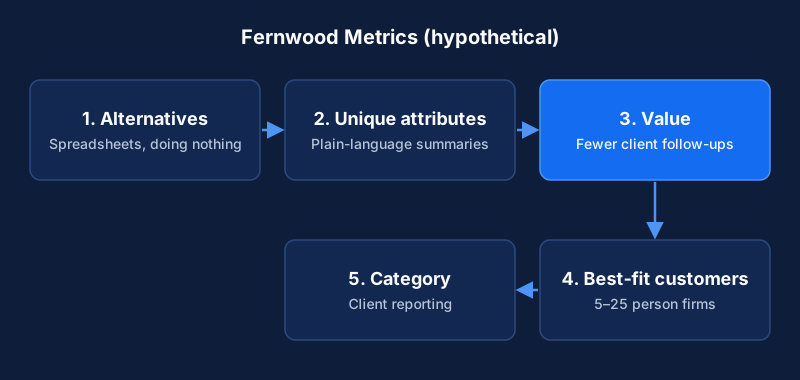
The "We are not for" line is the one teams skip. It is also the one that stops sales from chasing deals that do not fit. Keep the statement plain. If a new hire cannot say it back after one read, rewrite it.
Testing the statement
A statement written by the founder is a hypothesis. Test it three ways, cheapest first.
Say-back test. Run five to ten short calls with people in the ICP. Ask about the problem and how they handle it today, without showing any messaging. Then read the one-line statement and ask how they would describe it to their business partner. If they repeat the value in their own words, it works. If they call Fernwood another dashboard tool, the founder goes back to the differentiator.
Live calls. Use the statement on real calls for two weeks. Note where prospects interrupt, ask for clarification or change the subject. Those moments are the weak points.
Different outcomes call for different repairs. If prospects ask "so is this a dashboard?", the category is wrong or the differentiator is buried. If they nod and then ask about price, the value is not yet specific enough to weigh against cost. If they ask who else uses it, the gap is proof, not wording, and a better sentence will not close it.
Won and lost deals. Interview recent buyers and decliners about why they chose what they chose. The reasons reps type into a CRM are often wrong, as we describe in how to run a win/loss program. A test of headlines on a site with a few dozen visitors does not settle anything, so treat small traffic with care.
Rolling it out
A positioning document does nothing while it sits in a drive. Decide who changes what, and by when.
| Asset | Change | Owner |
|---|---|---|
| Homepage headline and subhead | Lead with the ICP, the problem and the outcome | Founder or marketing |
| Sales deck and discovery questions | Open with the buyer's situation, not the company's history | Sales |
| Outbound and LinkedIn copy | One message across sequences, posts and profiles | Marketing or founder |
| Case studies and proof | Choose stories that match the ICP | Marketing |
| Onboarding and product language | Use the words customers use | Product and success |
Before any of it ships, ask three people who were not in the room to read the one-pager and say what Fernwood does and who it is for. Their answers show whether the page works without your explanations.
Fix the homepage and the pitch first, because buyers see those first. Archive anything that contradicts the new position.
The hard part is consistency across people. A founder who sells well but describes the product three ways on three calls has created three positions. Write the pitch down the way you want it said, and capture it in a sales playbook so a new hire can use it. Getting one message across founder, sales and marketing is the focus of messaging alignment.
Where this goes wrong
Three failures show up often. A team starts from the roadmap, so the page lists features instead of a situation. A team picks an ICP so wide, such as "mid-market companies", that no single message can serve it. And a team forgets that "doing nothing" is an alternative, so it beats the named rivals and still loses to the spreadsheet.
Last, treat the page as living. Revisit it after each batch of customer and lost-deal interviews, and change the statement before you change the website.
Frequently asked questions
How long does it take to position a B2B product?
A first working draft takes a few focused days if you already have customers to talk to. Plan for several more weeks of testing in sales calls and on your site before you treat the statement as settled.
Who should own positioning in a founder-led company?
The founder should make the final call, because positioning is a business decision about who you serve and what you refuse to be. Sales and marketing should help write it and must be able to say it in their own words.
What is the difference between positioning and messaging?
Positioning is the decision about your alternatives, your audience, your differentiated value and your category. Messaging is how you express that decision in headlines, emails, decks and calls.
How do I know my positioning is working?
Prospects repeat your value back in their own words, sales calls spend less time on "how are you different", and the people who book calls look more like your ideal customer. Lost-deal interviews also show fewer comparisons on features alone.