Founder-Led Growth: Turn Founder Knowledge Into a System
By Shuk Huay Koh, Founder, Mir Tech
Published Updated 8 min read
On this page
Ask a founder-led company why its customers bought, and the honest answer is often "they talked to the founder." That is a good way to win the first customers. It is a poor way to win the fortieth, because the pitch, the proof and the instinct for who is a good fit all live in one person who also has a company to run.
A growth system moves that knowledge into forms other people can use. It has four outputs and one routine: a message brief, a few core ideas, channel habits, a sales playbook, and a monthly review that feeds what you learn back into the brief. Below is each piece, in the order we build them at Mir Tech.
Why the founder's knowledge is the asset
B2B buyers trust people faster than brands, and the founder usually has the most first-hand experience of the problem. Our guide to LinkedIn strategy for founders covers the research on thought leadership and how to run a personal profile.
The catch is time. A founder can write the best post of the quarter and then vanish for three weeks because of a board meeting or a customer emergency. Visibility that depends on spare hours disappears exactly when the company is busy, which is usually when it is growing.
So the goal is to make the founder's ideas travel further than the founder's calendar allows. Turning the founder into a full-time content creator is not the goal.
The flow in one picture
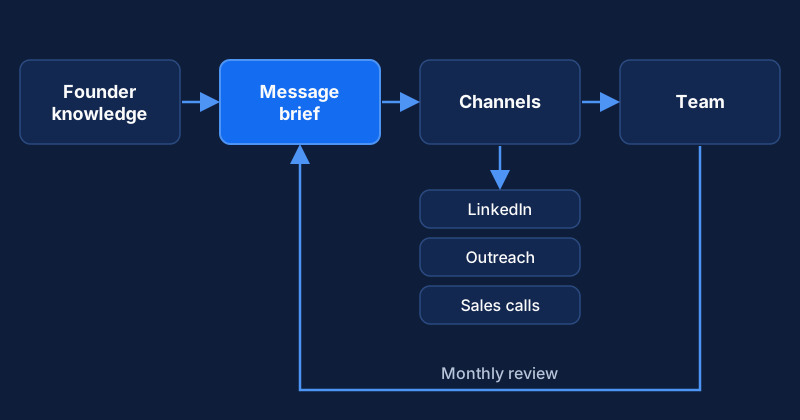
Each stage produces something a colleague can use without asking the founder. The brief comes first because every later stage is checked against it. Teams that start posting or emailing before they can state the message in a sentence get output that is polite and forgettable.
Ownership shifts as each layer matures:
| Layer | What it contains | Who owns it once built |
|---|---|---|
| Message | ICP, problem, positioning, proof | Founder first, then shared |
| Content | Core ideas, formats, a publishing rhythm | A marketer or contractor |
| Outreach | Targeting, sequences, conversation guides | Sales or a hired SDR |
| Sales process | Discovery questions, objections, handoffs | The sales lead |
| Feedback loop | What buyers say, what converts | Founder plus team |
The founder never leaves the first row entirely. Positioning is a judgment call, and judgment is the thing a founder cannot delegate.
Get the message out of the founder's head
Start with an interview, not a template. Sit down with the founder, or be the founder, and answer a short list of questions out loud while recording:
- Who were the last three customers you were glad to win, and why them?
- What did each of them try before you?
- How did they describe the problem in their own words?
- What do prospects misunderstand about what you do?
- Which objection comes up most, and how do you answer it?
Make the interview easier by having someone else ask the questions. A founder answering their own list tends to give the polished version, while a colleague who says "wait, why did they pick you over the cheaper option?" gets the real one. Ninety minutes is usually enough, and the follow-up questions matter more than the list. Ask for specific stories (the last deal, the last lost deal, the call that went badly) instead of general principles.
The transcript is raw material. From it you pull the buyer's language, the sharpest proof points and the opinions the founder holds that competitors do not. The output is a short document we call the message brief, and it is the single source everything else gets checked against.
Who we sell to (one ICP):
The problem, in the buyer's words:
How we describe the solution (one sentence):
What buyers usually misunderstand:
Proof we can show (customer, number, process):
Needs proof (open gaps):
Opinions we hold that competitors do not:
To make that concrete, here is a filled-in brief for an invented company, "Example Co", which sells spend-review software to finance leads at small SaaS companies. It is an illustration and does not describe a real client.
Who we sell to: Finance leads at SaaS companies with 20-100 staff
The problem, in the buyer's words: "I find out about a tool when the invoice lands"
How we describe the solution: A quarterly review that shows every subscription, its owner and whether anyone still uses it
What buyers usually misunderstand: They think it is an expense tool; it is a review habit
Proof we can show: Needs proof (no named customer yet)
Opinions we hold: Cutting tools is the smaller win; the bigger one is knowing who owns each contract
Note the "needs proof" line. A brief fails when it is aspirational. Only include claims you can back with a real customer, a number you own or a process you can show. If you have no proof yet, write "needs proof" and make collecting it a task, because an honest gap is more useful than a confident sentence nobody can defend. For a structured way to turn the answers into a positioning statement, work through the positioning framework.
Turn the brief into three to five core ideas
A core idea is an opinion plus the reasoning behind it. "Onboarding fails when the sales handoff drops the customer's goal" is one. It is specific enough to disagree with, and the founder can talk about it for twenty minutes.
One idea becomes many assets. The long version is a post or article with the full argument. Shorter posts each make a single point. Sales gets a talking point, a deck or one-pager gets a section, and a webinar or a podcast guest slot gets a topic. The founder has the conversation once and the team does the packaging.
Put the idea where buyers already look
For most founder-led B2B companies, the founder's LinkedIn profile is the most direct channel. The profile says who you help in the buyer's words. Posts come from the core ideas rather than from whatever happened that morning. A teammate can draft, schedule and track, but the founder approves every post and answers comments personally. A founder who disappears from the comments loses most of the value.
A common worry is that drafts written by someone else will not sound like the founder. The fix is cheap: give the drafter the transcripts and ten of the founder's own messages, then edit for voice before anything goes out. Within a few rounds the founder's edits shrink, and that shrinkage is a good sign the brief is doing its job.
Content builds familiarity, and outreach creates conversations with people who match your ICP. They work best when they say the same thing. The first line of an outbound message should refer to the problem the founder writes about, and the founder's posts should address the objections that come up on calls. If outbound says one thing and content says another, buyers notice.
Skills Union, which worked with Mir Tech on its messaging, aligned its content and outbound around one message and got 24 leads in six weeks, according to Tuyen Do, its Director of Partnerships. It is one company's result, not a forecast.
That alignment work is what we do under messaging alignment.
Write down how the founder sells
The founder is usually the best seller in the company, and that knowledge is the most fragile part of the system. Capture it in a lightweight playbook: the discovery questions the founder asks and why, the three or four objections with an honest answer to each, what a good-fit prospect says on the first call, what a bad-fit prospect says so the team can disqualify politely, and the next step after each type of call.
Record real calls with consent and annotate them. A playbook built from transcripts is more accurate than one built from memory, and it is much faster to write.
Review monthly and feed the brief
A system that does not learn goes stale. Once a month, with the founder in the room because the founder hears the market first, look at four questions. Which core ideas drew replies or conversations? Which objections are new? Where did deals stall? What do customers say about why they bought?
Update the language in the brief, drop ideas that go nowhere and add the ones buyers raise themselves. Keep a dated log of the changes, because the reasons for a change are easy to forget by the next quarter and a new hire can read the log to see how the message evolved. Count conversations, replies and the quality of sales calls alongside leads. Leads alone can hide a weak message for months.
One more habit pays off: ask every new contact how they heard of you, and write the answer down verbatim. Much of the influence in B2B happens in places tracking links never reach, such as a forwarded post, a conversation with a peer or a podcast, and the words people use here are often better copy than anything written in a meeting.
Where AI helps and where it does not
AI-assisted workflows suit the repetitive steps: transcribing calls, drafting a first version from an interview, repurposing a long piece into short ones and tidying a pipeline report. They are poor at deciding what the company believes. The founder supplies the opinion and the proof, the workflow produces drafts, and a person edits against the brief. The AI content pipeline describes one way to set that up, with review gates.
We would not automate anything before the brief is settled. Automation multiplies whatever message you feed it, including a confused one.
What to hand off first
Not every task is equally safe to delegate. A rough order, from safest to riskiest:
- Logistics. Scheduling posts, tracking replies, updating the pipeline sheet, booking calls. Nothing here needs the founder's opinion.
- Drafting from source material. First versions of posts and emails, written from transcripts and the brief. The founder edits.
- Follow-up. Post-call emails and resource sends, using the playbook's wording.
- First-touch outreach. The team writes and sends to the ICP list, with the founder reviewing the first batch and then samples.
- Discovery calls. Last, and only once recordings show someone else asking the playbook's questions the way the founder does.
Move one rung at a time and wait a month before the next. If quality drops, you know which handoff caused it, and the fix is a clearer brief or playbook. Taking the work back is rarely the answer.
A test you can run this week
Hiring is the usual next move, and we would delay it. A new marketer or SDR cannot invent the founder's point of view, so they guess, and the guesses show. Hire when the brief, the core ideas and the playbook exist, so the hire's first job is running a channel instead of defining the company.
To check whether you are ready, give someone outside the founder's head the brief and nothing else. Ask for a first outreach message and a first LinkedIn post. If they come back with questions only the founder can answer, those questions are the gaps in the brief. Fill them, and run the test again.
Frequently asked questions
What is founder-led growth?
It is a way of generating pipeline where the founder's knowledge, point of view and relationships drive early demand. The founder is the source of the message. The system's job is to carry that message to buyers through content, outreach and sales calls without the founder performing every step.
When should a founder stop being the main seller?
When you can write down, in a page, who you sell to, what problem you solve and why customers pick you. If those answers live only in your head, a new salesperson will not fix it. Document the message first, then hand off one channel at a time, starting with the one that needs the least of your judgment.
How much of the founder's time does the system need?
It depends on the stage, but plan on a protected block each week: a short interview or review of drafts, a look at pipeline, and a monthly review. The aim is to move the founder from doing the work to approving it. Buyers still want to hear from the person who built the thing, so the answer is never zero.
What if the founder dislikes writing or posting?
Record instead of writing. A twenty-minute voice memo or a sales call transcript gives a teammate enough to draft from, and the founder edits. Podcasts, customer calls and short replies in comment threads also count as visibility. Pick the format the founder will actually keep up.
How do we know the system is working?
Look at conversations before leads: replies to the founder's posts, prospects who quote your wording back to you, and whether new hires can write an on-message email from the brief alone. A weak message can still produce form fills, so leads on their own can hide a problem.
Related Content
How to Run a Win/Loss Program for a B2B Sales Team
A practical win/loss program for founder-led B2B teams: who to interview, what to ask, how to code reasons, and how to act on what you learn.
Content Distribution Playbook: One Core Piece, Many Channels
How small B2B teams can turn one strong piece of content into posts, emails, talks and sales assets, with a distribution plan you can run weekly.
LinkedIn Strategy for B2B Founders: Profile, Posts, DMs
A practical LinkedIn guide for B2B founders: position your profile, build a sustainable posting routine and turn replies into real sales conversations.