Your Pipeline Coverage Is a Vanity Metric. Focus on Velocity for Predictable Revenue.
The Great Deception: Why Pipeline Coverage Is a Flawed North Star
For years, my team and I have sat in boardrooms and QBRs where the conversation inevitably turns to one metric: pipeline coverage. The old rule of thumb, the 3x or 4x coverage model, is treated as gospel. It’s the metric leaders point to for reassurance and the number sales VPs are beaten with when it looks low. I’m here to tell you that this obsession is a dangerous oversimplification. A bloated pipeline is a vanity metric that creates false confidence, destroys forecast accuracy, and drives the absolute worst behaviors in a sales organization.
This isn't just a hunch. It's a well-documented problem. Consider the fact that research consistently shows over one-third of forecasted deals slip past their projected close dates. How is that possible when the pipeline coverage looks so healthy? The answer lies in what I call 'pipeline bloat'.
Pipeline bloat is the accumulation of a large number of open opportunities that are not, and likely never will be, viable deals. It happens when the pressure for volume eclipses the need for quality. When behavior follows incentives, a compensation plan that rewards raw pipeline generation without penalizing poor qualification will always produce a fat, unhealthy funnel. Reps, trying to hit their pipeline creation targets, stuff the early stages with low-intent prospects, unqualified leads, and "maybes" that have no real chance of closing. This creates a cascade of negative consequences. It wastes countless hours of seller time on deals that are dead on arrival. It burns through marketing dollars by misallocating expensive sales resources. And it gives your entire executive team a completely distorted view of the business.
This bloat connects directly to the forecasting crisis so many companies face. A large but stagnant pipeline makes forecasting an impossible guessing game. You are forced to rely on rep intuition and happy ears instead of data. When your funnel is clogged with deals that haven't moved in 60 days, how can you possibly predict what will close this quarter? You can't. Research confirms that forecast accuracy plummets when pipelines are bloated with these low-quality deals. This isn't a minor issue. In today's economic climate, predictability is paramount. The data is clear: companies with accurate sales forecasts are 10% more likely to grow revenue year-over-year than their less-predictable peers.
It’s time to change the conversation. We need to stop asking, "How big is our pipeline?" and start asking, "How healthy and efficient is our pipeline?" The path forward requires a fundamental shift in focus, away from static volume and toward dynamic velocity. We must concentrate on the speed and efficiency with which real opportunities move through our defined sales process. This is the foundation of pipeline velocity, a measure of how quickly your sales process generates revenue. It’s about building a lean, mean, revenue-generating machine, not a stagnant reservoir of false hope.
The Velocity Trinity: Core Metrics for a Healthy Revenue Engine
To build this efficient revenue machine, my team and I threw out the old obsession with coverage and anchored our entire operational strategy on what we call the "Velocity Trinity." These are three interconnected metrics that, when measured and managed correctly, provide a complete picture of pipeline health and expose the precise areas that need intervention.
1. Average Sales Cycle Time
The first and most straightforward metric is the Average Sales Cycle Time. This is the total time elapsed from the moment an opportunity is created in your CRM to the moment it is marked ‘Closed-Won’. It is the 30,000-foot view of your sales process efficiency. While we calculate this across the entire pipeline, it's critical to understand the benchmarks. For many B2B SaaS companies, the median sales cycle is approximately 84 days. This figure can stretch significantly for more complex, high-value deals. Enterprise opportunities, those over $100,000 in annual contract value, often require 90 to 180 days, and sometimes longer, to navigate procurement, legal, and security reviews. Knowing your average cycle time is the starting point, but it's just that: a starting point. It tells you what is happening, but not why.
2. Days in Stage
This brings us to the second and, in my opinion, most critical diagnostic metric we use: Days in Stage. While the overall sales cycle time is a useful indicator, it's an aggregate that can hide significant problems. Days in Stage breaks that aggregate down, showing you exactly how long the average deal spends in each phase of your sales process. This is where the real insights live.
By building reports that compare the current average time a deal sits in each stage against our historical averages, we can immediately pinpoint bottlenecks. Is the average deal stuck in the 'Technical Validation' stage for 45 days when it used to be 25? That signals a problem. Perhaps our sales engineers are overloaded, or our product has a new integration complexity we haven't accounted for in our sales motion. Is the 'Contract Negotiation' stage ballooning? Maybe our legal team is understaffed, or our new master services agreement is filled with language our customers are pushing back on. Days in Stage transforms a vague problem ("our sales cycle is too long") into a specific, addressable issue ("deals are stalling in negotiation").
3. Stage-to-Stage Conversion Rate
The third piece of our trinity is the Stage-to-Stage Conversion Rate. This is a far more powerful metric than the overall win rate. An overall win rate simply tells you what percentage of created opportunities eventually close. If your win rate is 22%, what do you do with that information? It’s a black box.
Analyzing the drop-off between each specific stage, however, provides immediately actionable intelligence. It shows you precisely where deals are dying in your funnel. For example, a significant drop-off often occurs between the Marketing Qualified Lead (MQL) and Sales Qualified Lead (SQL) stages. Industry benchmarks show that this conversion rate can be as low as 13-26%. If your rate is below that, it might indicate a misalignment between sales and marketing on lead definitions. Conversely, if you see a high conversion from MQL to SQL, but a massive drop-off from 'Discovery' to 'Proposal', your reps might be having great initial conversations but are failing to build a compelling business case. Each drop-off point tells a different story and demands a different solution.
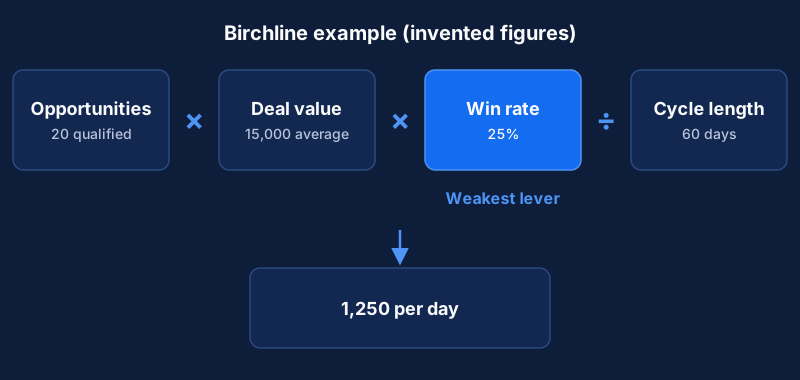
These three metrics are not independent. They are the core components of the classic Sales Velocity Equation:
(Number of Qualified Opportunities × Average Deal Size × Win Rate) ÷ Length of Sales Cycle
Many leaders see this formula and focus only on the final number. We see it differently. We don’t manage to a single velocity number. Instead, we position this equation as a framework. Our "trinity" metrics are the individual levers within this formula that we can actively influence. By reducing the Length of Sales Cycle (via Days in Stage analysis) and improving the Win Rate (via Stage-to-Stage Conversion analysis), we directly and systematically increase the output of our entire revenue engine.
A Framework for Pinpointing and Eliminating Bottlenecks
Having the right metrics is one thing. Building a repeatable system to act on them is what separates high-performing RevOps teams from the rest. We developed a four-step framework to move from data to diagnosis to action, ensuring we are always targeting the true source of inefficiency in our sales process.
Step 1: Impose Rigorous Data Hygiene and Segmentation
The absolute foundation of any meaningful analysis is clean, reliable data. This is non-negotiable. As the old saying goes, "garbage in, garbage out." Before you can trust any report, you must have enforced standards for data entry, clearly defined sales stages with exit criteria, and automated processes to maintain data integrity. The cost of ignoring this is staggering. According to Gartner, poor data quality costs businesses an average of $12.9 million every year.
Once your data is clean, you must resist the urge to rely on top-level averages. Averages lie. A company-wide sales cycle of 90 days might look perfectly acceptable, but it could be masking a critical problem. That 90-day average could be composed of an enterprise team with a 150-day cycle and a mid-market team with a 45-day cycle. Without segmentation, you would never know where to focus your efforts. We analyze all our velocity metrics by team, by region, by product line, by deal size, and by lead source. This deep segmentation is the only way to isolate the actual source of a problem and apply a precise solution rather than a blunt instrument.
Step 2: Conduct a 'Days in Stage' Audit
With a clean, segmented dataset, we conduct a formal 'Days in Stage' audit every month. This is our primary diagnostic tool. We build reports in our business intelligence platform that visualize the average number of days opportunities spend in each stage, benchmarked against the previous six months of historical data. We are specifically looking for anomalies, for stages where the duration is creeping up.
I recall a specific audit where we identified that our 'Proposal Sent' stage had swelled from an average of 15 days to over 30 days in a single quarter. The aggregate sales cycle had only ticked up slightly, but this specific stage was a flashing red light. Digging in, we found that reps were sending proposals prematurely, before fully confirming the budget and decision-making process. The proposal would then sit in the prospect's inbox for weeks with no action. The data pointed us directly to a process failure. In response, we implemented stricter exit criteria for the preceding stage, requiring documented confirmation of the buying process. We also introduced a mutual action plan template as a required activity before a proposal could be generated. The result was immediate. Within two months, the time in that stage was cut by more than half, because deals only entered it when they were truly ready.
Step 3: Visualize and Analyze Conversion Rate Drop-offs
Next, we visualize the sales funnel to scrutinize our stage-to-stage conversion rates. A simple funnel chart that shows the percentage of deals that advance from one stage to the next is one of the most powerful views in our RevOps dashboard. The key is knowing how to interpret the drop-offs. A significant dip at the top of the funnel tells a very different story than a dip at the bottom.
For example, a low conversion rate between 'Sales Qualified Lead' and 'Discovery/Meeting Booked', where average B2B conversion can be as low as 30-40%, almost always points to an issue with lead qualification or initial follow-up. Are our MQL criteria too loose? Is our BDR team properly enabled to handle objections and set appointments? In contrast, a steep drop-off between 'Negotiation' and 'Closed Won' signals a different set of problems. This suggests we are getting out-maneuvered on price, failing to prove sufficient ROI against budget scrutiny, or getting stuck in protracted legal and security reviews. The visualization doesn't give us the answer, but it tells us exactly where to start digging and what questions to ask.
Step 4: Correlate Sales Activity Data with Velocity Metrics
The final step in our framework is to layer in activity data. Velocity metrics tell us what is happening in the pipeline, but activity data helps explain why. It's shocking how much of a seller's time is consumed by non-selling tasks. Various studies have found that reps can spend up to 72% of their time on administration, data entry, and other internal tasks. By correlating activity data from our sales engagement platform and CRM with our velocity metrics, we can start to answer critical coaching questions.
Is a bottleneck in the 'Technical Validation' stage caused by a lack of activity, meaning the rep isn't doing enough to engage the technical buyer and push the evaluation forward? Or is it a systemic process failure, where the sales engineering team is simply too backlogged to respond in a timely manner? The data helps us distinguish between a skill or will issue with the rep and a genuine process breakdown. This is essential for delivering effective coaching that is targeted and data-driven, rather than based on gut feel. It allows us to say, "I see your deals are stalling in the proposal stage, and the data shows you haven't had a meeting with the economic buyer in 90% of those opportunities," which is far more powerful than, "You need to close more."
From Insight to Action: Tactical Levers to Improve Velocity
Identifying bottlenecks is only half the battle. A world-class revenue operations function must translate those insights into a tactical playbook that sales teams can execute. Once we’ve used our framework to pinpoint a problem, we deploy a series of specific, proven levers to improve pipeline velocity. These are not one-size-fits-all solutions but are prescribed based on the specific diagnosis.
Lever 1: Reducing Sales Cycle Time
When our 'Days in Stage' audit reveals a particular stage is taking too long, we focus on two primary tactics:
-
Implement Mutual Action Plans (MAPs): These are one of the most effective tools for preventing deal stall. A MAP is a shared document that aligns both the buyer and the seller on the key milestones, responsibilities, and timelines required to reach a decision. It turns a nebulous sales process into a clear, collaborative project plan. Instead of the seller chasing the buyer for updates, both parties are accountable to the agreed-upon plan. This transparency and mutual accountability is powerful. Data shows that using a well-structured mutual action plan can increase win rates by 26%. We introduced MAPs as a mandatory step before the 'Technical Validation' stage, and it dramatically reduced the "ghosting" we saw after initial demos.
-
Automate Non-Selling Tasks: Seller time is your most precious and expensive resource. Every minute a rep spends on administrative work is a minute they are not talking to customers. Given that reps can spend up to 71% of their day on non-revenue generating activities, this is a massive area of opportunity. We conduct regular audits of our sales process to identify and eliminate friction. This includes automating quote generation, integrating our CRM with our proposal software to pre-populate templates, and using conversation intelligence tools to automatically log call notes. Each small automation reclaims valuable selling time, allowing reps to focus on the high-impact activities that actually move deals forward.
Lever 2: Increasing Stage-to-Stage Conversion Rates
When our funnel analysis reveals a significant drop-off between stages, we deploy tactics focused on improving qualification and competitive differentiation:
-
Operationalize a Qualification Methodology: You cannot leave qualification to chance. We operationalized the MEDDPICC framework across our entire sales organization. MEDDPICC provides a common language and a rigorous checklist (Metrics, Economic Buyer, Decision Criteria, Decision Process, Paper Process, Identify Pain, Champion, and Competition) to ensure we are pursuing the right deals. This isn't just theory. Adopting a methodology like MEDDPICC has been shown to improve win rates by as much as 18% in complex enterprise deals. We built it directly into our CRM, with required fields for each element that must be completed before an opportunity can advance to a later stage. This enforces discipline and gives managers a clear framework for deal reviews and coaching.
-
Create Stage-Specific Battle Cards: Objections don't happen randomly. They tend to cluster at specific points in the sales cycle. In the early stages, you get objections about timing and need. In the late stages, you get objections about budget and implementation. We work with our product marketing team to create and maintain a library of battle cards tailored to the objections most commonly encountered at each stage. If we see a high drop-off after the first demo, we equip our reps with battle cards specifically designed to handle initial price objections and differentiate us from the competition right out of the gate. This proactive enablement gives reps the confidence and content they need to overcome hurdles at critical conversion points.
Lever 3: Benchmark for Continuous Improvement
To know if our interventions are working, we need benchmarks. But it's crucial to use them correctly.
-
Your Primary Benchmark is Yourself: The most important comparison is against your own historical data. Our goal is continuous, incremental improvement. Are we reducing the time in the negotiation stage by 10% quarter-over-quarter? Did we increase the conversion rate from 'Discovery' to 'Proposal' from 40% to 45%? This internal focus keeps the team motivated and centered on what they can actually control.
-
Use Industry Data for Context: While we prioritize internal benchmarks, we use industry reports for directional context. Knowing that average B2B sales cycles can range anywhere from 3 to 9 months depending on deal size and complexity helps us set realistic expectations with our board and understand where we sit in the broader market. But we never treat these external numbers as rigid targets. Every business is different, and what matters is making your revenue engine more efficient than it was last quarter.
Operationalizing the Strategy: The Weekly Pipeline Health Meeting
Finally, we bring this entire strategy to life through our weekly pipeline health meeting. This is the operating rhythm that ensures our focus on velocity is more than just a dashboard, it's a core part of our sales culture. This meeting is not a traditional forecast call where reps simply report on their deals. It is a structured, data-driven dialogue.
The agenda is fixed. We start by reviewing the 'Velocity Trinity' metrics for each team, segmented and benchmarked against the last period. We then zero in on the two biggest opportunities and the two most "at-risk" deals (defined by a deal that has exceeded the average Days in Stage). The discussion is not about the rep giving a status update. It's a strategic conversation focused on, "What is the next concrete action we can take to move this deal forward?" and "What resources do you need to de-risk this opportunity?" Every meeting concludes with clear, documented action items assigned to specific individuals, which are reviewed at the start of the next meeting. This creates a powerful feedback loop of accountability and ensures that our insights are consistently translated into action. This is how you stop admiring the problem of a bloated pipeline and start building a high-velocity revenue machine.
Related Content
Your Churn Problem Is a Data Problem: A CS Leader’s Framework for Predictive Analytics
Stop reacting to churn. As a CS leader, learn my framework for building a predictive model that identifies at-risk customers 30 to 60 days in advance.
Technical Architecture: A Unified Customer Touchpoint Tracking System
A technical guide for systems architects to map and track all customer touchpoints using a CDP, CRM, and analytics for complete journey visibility.