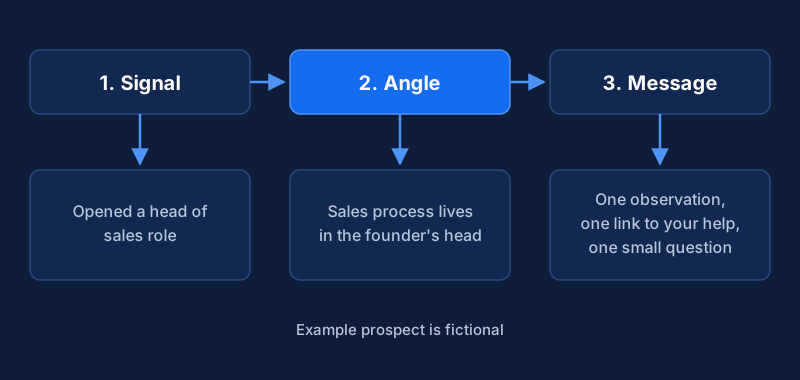
Beyond {{FirstName}}: The Growth Team’s Playbook for Personalization at Scale
Introduction: Your 'Personalization' is Broken
I'll start with a hard truth: your team's approach to B2B personalization is probably a glorified mail merge, and it’s failing. If you are reading this, you have likely felt the sting of declining engagement. You have seen meticulously crafted campaigns get sent to the digital void, met with silence. This isn't just a feeling; it's a statistical reality. The average reply rate for cold B2B emails has plummeted to a dismal 5.8%. For every hundred emails your team sends, ninety-four are effectively dead on arrival. Your SDRs are burning cycles on outreach that gets ignored, and your pipeline is suffering as a result.
The core problem isn't a lack of effort. Your team spends hours scraping lists, verifying titles, and plugging custom fields into templates. The issue is a fundamentally flawed model. The standard playbook relies on static, easily-scraped firmographic data: company size, industry, revenue, and employee title. You are personalizing based on information that every single one of your competitors also has access to. This isn’t personalization; it’s a race to the bottom, a competition to see who can state the obvious in the most creative way.
This approach is not only ineffective, but it's also actively damaging your brand. Modern B2B buyers are sophisticated and time-poor. They have developed a powerful filter for irrelevant noise. Research shows that 73% of B2B buyers actively avoid vendors who send them irrelevant outreach. Every time your team sends an email that says, "I see you're the VP of Marketing at and I wanted to talk about our marketing solution," you are not just getting ignored. You are training that prospect to delete your emails on sight for the next two years. You are becoming part of the noise, not the signal.
My thesis is simple, but its execution is what separates top-performing growth teams from the rest. Real personalization at scale does not come from more manual research or more clever mail-merge fields. It comes from building an operational system. A system that identifies, captures, and translates real-time interest signals into automated, yet genuinely relevant, messaging. It's about shifting from a strategy of interruption to a strategy of timely intervention. In this post, I will outline the exact philosophy, framework, and technical stack we built to solve this problem, moving from a world of generic blasts to a system of signal-driven engagement.
The Personalization Paradox We Had to Solve
Every growth leader I know is wrestling with the same central conflict: the personalization paradox. This is the seemingly inverse relationship between scale and relevance. On one hand, you have the pressure to grow, to hit bigger numbers, and to reach more accounts. This pressure pushes you toward automation and volume. On the other hand, you know that genuine, one-to-one personalization is what actually earns a reply. This pressure pushes you toward manual research and customized messaging. As you push the lever for scale, the quality of personalization drops. As you push the lever for personalization, the volume you can handle plummets. Your team is caught in the middle.
This conflict is why the standard approach fails. The common "solution" is to use dynamic tags like {{first_name}}, {{title}}, and {{company}} in a mass email template. But sophisticated buyers see through this in a nanosecond. It doesn't demonstrate any real understanding of their context, their immediate challenges, or their priorities right now. It's a hollow gesture. We know that B2B buyers are just consumers in a professional context, and a report from McKinsey found that 71% of consumers expect personalized interactions. This expectation doesn't vanish when they log into their work email. In fact, the stakes are higher. A poor consumer experience might lose a $50 sale; a poor B2B experience can cost a $500,000 deal. The data backs this up, showing that 65% of B2B buyers are willing to switch brands if they feel a company isn't personalizing communication to their specific needs.
Attempting to scale a broken model only amplifies its flaws. Sending 10,000 generic emails a month instead of 1,000 doesn't just produce ten times the silence; it produces ten times the brand damage. You are burning through your total addressable market with outreach that makes you look lazy and uninformed.
The solution my team implemented was to reject this false choice between scale and personalization. We realized we could have both, but it required a completely different mental model. We had to build a hybrid system. Our model automates the architecture and delivery of our messaging. It automates the "who" and the "when." But the substance of the message, the "what" and the "why," is triggered by genuine, observable prospect signals. We let our prospects' behavior dictate our outreach strategy. This approach is the foundation of our entire growth engine. It allows us to automate the mechanical work so our team can focus on the high-judgment tasks, creating a system that is both efficient at scale and deeply relevant at the individual level.
Signal Layering: From Basic to Sophisticated
To operationalize our hybrid model, we had to create a structured way to think about prospect data. We couldn't treat a CEO who just raised a $50 million funding round the same way we treated a manager at a company that vaguely fits our demographic profile. This led us to develop a framework we call 'Signal Layering'. It's a hierarchy we use to categorize every piece of prospect data, which in turn determines the appropriate level of personalization and the right degree of automation for our outreach. We classify all incoming signals by their intent strength, sorting them into three distinct layers: weak, medium, and strong.
Layer 1 (The Foundation): Basic Intent Signals
This is the widest, most foundational layer of our targeting strategy. It combines our static Ideal Customer Profile (ICP) with broad, high-level intent signals. The ICP is our baseline filter. It includes the firmographics you’d expect: company size, industry, geography, and specific technologies they use. But we don't stop there. We enrich this static data with what we call "basic intent". This data comes from third-party providers and shows that a company, as a whole, is researching topics or keywords related to our solution category. They are demonstrating early-stage interest, but it's anonymous and not tied to a specific individual's actions.
Examples of Layer 1 Signals:
- A company in our ICP (e.g., 500-2000 employee SaaS) shows a spike in research around "sales engagement platforms."
- Multiple IP addresses from a target account are reading articles on G2 about our competitors.
- A company fits our technographic profile (e.g., uses HubSpot and Salesforce) and is in a high-growth industry.
Accounts in this layer are qualified for broad, automated sequences. The messaging here is not hyper-personalized. Instead, it is persona-relevant. We speak to the common challenges of a specific role (e.g., a VP of Sales at a tech company) and use our value proposition as the hook. The goal at this stage is not necessarily to book a meeting, but to educate, establish our brand, and stay top-of-mind so that when their interest intensifies, we are the first company they think of. This is our air cover, warming the market at scale.
Layer 2 (Active Engagement): Behavioral Triggers
This is where personalization begins to sharpen. Layer 2 signals are behavioral triggers that come from our own digital properties. These are much stronger buying signals because they are actions taken by a specific, identifiable individual from a target account. They are no longer anonymously researching a category; they are actively engaging with our content and solution. This signals a shift from passive curiosity to active evaluation.
These signals tell us what problems they are trying to solve right now. Someone who downloads a competitor comparison guide has a different immediate need than someone who repeatedly visits our integration page. Our system is built to recognize this context and respond accordingly.
Examples of Layer 2 Signals:
- A prospect from a target account visits our pricing page three times in one week.
- An executive downloads our "Ultimate Guide to Sales Automation" whitepaper.
- Multiple stakeholders from the same company attend our webinar on "Scaling Outbound Teams."
- A contact clicks through on a specific case study in our email newsletter.
Each of these triggers automatically enrolls the prospect into a more specific, problem-aware messaging sequence. The sequence for the pricing page visitor is different from the one for the webinar attendee. The pricing page visitor gets a direct, benefit-oriented message that addresses cost versus value. The webinar attendee gets a follow-up that references a key concept from the presentation and offers a deeper consultation on that specific topic. The automation handles the delivery, but the message is directly tied to a specific action they took, making it feel timely and relevant, not random and cold.
Layer 3 (High-Value Triggers): Acute, Event-Driven Signals
This is the top of our pyramid, representing the strongest buying signals we can track. Layer 3 signals are acute, event-driven triggers that indicate a significant change is happening within a target organization. These events often create a compelling reason to buy new technology, review existing contracts, and re-allocate budget. They represent a window of opportunity where our outreach can solve an immediate and pressing business need. These are the moments that justify breaking from full automation and introducing a human-in-the-loop.
Examples of Layer 3 Signals:
- New Executive Hire: A target account hires a new CRO or VP of Sales. A new executive, especially in the first 90 days, has a mandate for change. They will review their entire tech stack, their team's performance, and their budget. Our outreach here is highly customized, congratulating them on the new role and positioning our solution as a tool to help them achieve a quick win and make an immediate impact.
- Company Funding Round: A company in our ICP announces a Series B or C funding round. This cash infusion is almost always earmarked for growth, which means scaling their sales and marketing teams. This is a powerful trigger. Our message will acknowledge the funding and connect our solution directly to their new objective of rapid expansion and efficient customer acquisition.
- Mergers and Acquisitions: When a company is acquired or merges with another, there is often a period of technological consolidation. They need to integrate disparate systems and processes. This is an ideal time to introduce a platform that can standardize their operations and create a unified system of record.
- Negative Competitor News: A direct competitor of a target account is mentioned in the news for a product failure, security breach, or poor earnings. This creates an opening to position our solution as a more reliable, secure, or effective alternative.
These high-value triggers are flagged in our CRM and routed to a senior team member for review. The system may suggest a template, but the final message is hand-customized to ensure the context is perfect. The cost of a clumsy, automated message at this critical juncture is too high. Layer 3 is where we blend automation with craftsmanship to engage our most valuable prospects at the perfect moment.
Template Architecture for True Scale
A signal-driven strategy is useless without a messaging framework that can adapt to those signals in real time. Writing thousands of unique, static email templates is not scalable. It creates a maintenance nightmare and leads to inconsistent messaging. My team solved this by moving away from traditional templates altogether. We developed a system we call 'Modular Messaging'. Instead of monolithic email templates, we built a library of interchangeable components, or snippets, that can be assembled on the fly based on the specific signals a prospect has triggered.
This approach gives us the consistency of a core message combined with the flexibility of near-infinite customization. The system is comprised of two main types of components: the 'stable core' and 'variable snippets'.
The 'stable core' is the unchanging foundation of our message. It contains our fundamental value proposition, a key data point or piece of social proof, and our primary call to action. This part of the message is consistent across most of our outreach because it represents the essential truth of our product. It’s our north star. For example, our stable core might be a two-sentence block that says: "Our platform helps growth teams like yours increase outbound meeting rates by 30% by automating signal-based follow-up. We've helped companies like [Similar Customer 1] and [Similar Customer 2] build a more efficient pipeline."
The 'variable snippets' are where the magic happens. These are pre-written paragraphs, sentences, or case studies designed to address a specific trigger, pain point, or persona. We have dozens of these in our content library, each tagged with the signal it corresponds to.
Examples of Variable Snippets:
- 'New CMO' Snippet: "Congratulations on the new role at . I know the first 90 days are all about assessing the current demand gen engine and finding opportunities for quick wins. Many new marketing leaders use our platform to get immediate visibility into pipeline influence and prove ROI."
- 'Recent Acquisition' Snippet: "I saw the news about your acquisition of [Acquired Company]. Integrating sales processes and tech stacks can be a huge challenge. Our platform is often used in these scenarios to create a single, unified engagement workflow for the newly combined GTM team."
- 'Competitor Guide Download' Snippet: "Thanks for downloading our guide comparing our solution to [Competitor Name]. One key area where our customers find we excel is [Specific Differentiator], which directly impacts [Business Outcome]. "
- 'Pricing Page Visit' Snippet: "I noticed someone from your team was exploring our pricing and plans. To add some context, most of our customers on the Pro plan see a full return on their investment within the first six months, primarily through improved SDR efficiency."
When a prospect triggers a signal, our sales engagement platform automatically assembles an email. It starts with a personalized opening line, inserts the relevant variable snippet based on the trigger, adds the stable core, and finishes with a clear call to action.
To govern this assembly process, we follow what I call the '10/80/10 Rule' for structuring every message.
- The First 10%: This is a hyper-personalized, often manually written or reviewed, opening line. Its only job is to grab attention and prove that this is not a generic email. For high-value Layer 3 triggers, this is always written from scratch. For Layer 2, it might be a semi-automated line like, "Saw you attended our webinar on yesterday."
- The Middle 80%: This is the automated core of the message. It's the assembly of our modular components: the relevant variable snippet followed by our stable core. This section does the heavy lifting, connecting the prospect's specific context to our core value proposition and benefits.
- The Final 10%: This is a clear, simple, and singular call to action (CTA) and a clean signature. We never ask for "15 minutes" in the first email. Instead, we use interest-based CTAs like, "If you're interested in learning how we achieve [Business Outcome], I can send over a brief video walkthrough." This lowers the friction and makes it easier for the prospect to say yes.
This modular, rule-based system allows us to send thousands of highly relevant, context-aware emails every week without sacrificing quality or overwhelming our team with manual tasks. It is the engine that translates our signal layering strategy into tangible conversations.
Our Tools and Automation Stack
A strategy like this is only as good as the technology that powers it. Building a signal-driven growth engine requires a tightly integrated stack where data flows seamlessly from intelligence tools to a central brain and finally to an action layer. Here is a breakdown of the categories of tools we use and how they function together.
The Central Nervous System: Our CRM
The entire operation is built around our Customer Relationship Management (CRM) platform, which for us is HubSpot. The CRM acts as the central nervous system, the single source of truth for all prospect and customer data. Its primary job is to aggregate every signal from all our disparate sources into a unified contact and account record. We live and die by the quality of data in our CRM. A well-configured CRM can be a massive asset; studies show that using a CRM can increase sales by up to 29% precisely because it centralizes this kind of customer intelligence. We use custom properties and objects extensively to track every signal, from Layer 1 intent topics to specific Layer 2 content downloads.
The Intelligence Layer: Signal-Gathering Tools
This layer is composed of various tools that identify the "who" and the "why." They are our eyes and ears in the market, feeding a constant stream of signals into the CRM.
- People and Company Intelligence: We use LinkedIn Sales Navigator heavily. It’s indispensable for tracking Layer 3 triggers like job changes ("people moves") and for identifying key decision-makers within our target accounts. We build lead lists based on our ICP and set up alerts for any changes within those accounts.
- Third-Party Intent Data: To capture Layer 1 signals, we use an intent data provider like Bombora. This tool tells us when our target accounts are showing an unusual level of research activity around specific keywords and topics relevant to our industry. This data is piped directly into a custom object on the account record in HubSpot, flagging companies that are in an early-stage buying cycle.
- First-Party Behavioral Data: Our strongest signals come from our own digital properties. We use HubSpot's own tracking code on our website to monitor page visits, content downloads, and form submissions. These Layer 2 signals are incredibly valuable because they represent direct engagement with our brand. A visit to the pricing page is one of the most powerful indicators of buying intent we can track.
The Action Layer: Sales Engagement Platform
This is where the signals are converted into action. Our Sales Engagement Platform (SEP), Salesloft, is the muscle of our operation. It reads the data from HubSpot and executes the appropriate messaging sequence. The key to making this work is a robust integration and a well-defined set of automation rules.
The SEP doesn't just send emails. It manages the entire outreach cadence across multiple channels, including email, calls, and LinkedIn connections. The automation rules engine is what brings our modular messaging framework to life, pulling in the correct snippets based on the custom fields synced from the CRM.
An Example Workflow in Action
To make this tangible, let's walk through a complete, end-to-end workflow for a high-intent Layer 2 signal:
- The Signal: A known contact, Sarah, who is a VP of Sales at a target account, visits our website's pricing page for the second time in three days. HubSpot's tracking code fires and records this page view activity on her contact record.
- The Integration & Triage (HubSpot): We have a HubSpot workflow built for this exact scenario. The workflow's enrollment trigger is "Contact has viewed URL containing 'pricing' at least 2 times in the last 7 days." Once Sarah meets this criteria, the workflow automatically updates a custom contact property we created called 'Intent Status' to the value "High - Pricing Page."
- The Automation (Salesloft): The 'Intent Status' custom field is configured to sync in real-time between HubSpot and Salesloft. In Salesloft, we have an automation rule that is constantly listening for this change. The rule is simple: "IF a person's 'Intent Status' changes to 'High - Pricing Page' AND they are not currently in an active cadence, THEN add this person to the 'High Intent - Pricing' cadence."
- The Action (Salesloft): Sarah is automatically added to the designated cadence. The first step in this cadence is an email. The email template is built using our modular system. It pulls in a personalized opening line, the specific 'Pricing Page Visit' variable snippet, our stable core, and a soft CTA. The email that lands in Sarah's inbox a few hours later feels incredibly timely and relevant to what she was just researching, dramatically increasing the probability of a reply.
This closed-loop system of Signal -> Integration -> Automation -> Action is the engine that allows us to personalize our outreach at scale. It ensures that the right message gets to the right person at exactly the right time, with minimal manual intervention.
Common Mistakes That Tank Response Rates
Building this kind of system is a powerful force multiplier for a growth team. However, it’s not foolproof. There are several common but critical mistakes that can undermine the entire strategy, destroy trust, and tank your response rates. We learned many of these lessons the hard way.
1. Faking Familiarity
This is the fastest way to get your email deleted and your domain flagged as spam. It's the outreach that starts with a transparently false premise like, "I saw your insightful post on LinkedIn..." when it's clear the sender has no idea what the post was about. This is worse than sending a generic email because it’s dishonest.
- Bad Example: "Hi John, I loved your recent post on LinkedIn! So insightful. Anyway, I sell accounting software..."
- Good Example: "Hi John, your LinkedIn post about the challenges of closing the books at quarter-end really resonated. You mentioned the friction of manual reconciliation. Our platform automates that process, often cutting close time by 4-5 days for finance teams like yours."
The good example works because it doesn't just mention the post; it connects a specific point from the post to a specific problem we solve. If you aren't going to take the 30 seconds to do that, don't mention the post at all. Including a genuinely personalized message in a LinkedIn connection request can boost the acceptance rate to over 9%, but a fake one will get you ignored.
2. Over-Automating High-Value Touches
Automation is for efficiency, not for abdication of judgment. A critical error is allowing a fully automated message to be the first touch with a high-value, Layer 3 prospect. When a target account hires a new CMO, the automated "New CMO" snippet is a great starting point, but it's not the final product. The context might be more nuanced. What if the CMO came from a company that was a current customer? What if their predecessor was fired for failing to adopt new technology?
My team mandates a "human-in-the-loop" review for all initial outreach triggered by Layer 3 signals. The system flags the contact and the event, suggests the relevant modular components, and assigns it to an account executive. The AE's job is to take the final 10% of the way, ensuring the context is perfect and the tone is exactly right before hitting send. This prevents us from rushing valuable leads into a generic pipeline before they've been properly qualified and engaged.
3. Ignoring Negative Signals
A signal-based system must also listen for negative signals. Continuing to send a growth-focused pitch to a company that just announced a round of layoffs or a major restructuring is completely tone-deaf and can cause irreparable brand damage. It makes your company look uninformed and insensitive.
Our system includes suppression rules based on this kind of negative news. We use alerts from news APIs and services that track company health. When a negative trigger event like "layoffs" or "executive departure" is detected for a target account, a workflow automatically pauses all active cadences for that account for 60-90 days. This is a simple but crucial safeguard that protects our brand's reputation.
4. Building on a Foundation of Bad Data
Finally, the entire system collapses on a foundation of bad data. Data hygiene is not a glamorous topic, but it is the absolute, non-negotiable prerequisite for this entire strategy to work. Automation amplifies everything, including errors. If your CRM data is a mess, you will be personalizing at scale with the wrong names, the wrong titles, and the wrong company information. This doesn't just make you look incompetent; it can be costly. Estimates suggest that poor data quality can cost companies as much as 20% of their annual revenue.
We enforce rigorous data hygiene through mandatory fields, field validation rules in our CRM, and regular data cleansing cycles with verification tools. Every piece of data entering our system is a building block for our messaging. If the blocks are cracked, the entire structure is unsound. Investing in data quality isn't an expense; it's an investment in the core asset that powers your entire growth engine.
Related Content
System Architecture for Proactive Customer Churn Prediction
My architectural guide to building an advanced, automated system that predicts customer churn by integrating product analytics, a data warehouse, and alerts.
System Architecture: Implementing User Action-Triggered Messaging
A technical guide for architects to implement a system that sends automated, personalized messages based on user actions like page visits and form fills.
System Guide: Automating Email Compliance for GDPR, CAN-SPAM, and CASL
My technical guide for automating email compliance. This system integrates an email provider, preference management, and data governance tools in five steps.