The LinkedIn Long Game: The B2B Founder's Framework for Building an Audience That Buys
Your Personal Brand is Your Company's Greatest Moat
I need to start with a hard truth. Most founders treat LinkedIn like a dusty resume or a digital billboard for their product. They post press releases, feature updates, and funding announcements into a void, wondering why no one cares. They are leaving an immense amount of value on the table. Your personal brand is not a vanity project. It is a strategic asset. It is a competitive advantage that no one can copy. It is your company’s greatest moat.
The reason is simple. People buy from people, not from logos. In the world of complex B2B sales, where deals are worth five, six, or seven figures, trust is the only currency that matters. A potential customer needs to trust your company, your product, and most importantly, you. Research confirms this human-centric reality. One study found that 82% of people are more likely to trust a company if its senior executives are active on social media. A strong founder brand builds that trust at scale, long before a sales call ever happens. It warms up the entire market for your product.
On LinkedIn, I see two types of founders. The first is the ‘Pitcher’. This founder’s feed is a relentless stream of self-promotion. “We just launched X feature!” “Check out our new case study!” “Book a demo with me today!” These posts are met with silence. They get ignored because they ask for value without providing any first. The second type is the ‘Builder’. This founder shares hard-won insights from their journey. They create discussions around industry problems. They teach their audience something valuable. The Builder gets inbound leads. They attract partners. They build a community. My team has analyzed thousands of accounts. We have seen personal profiles consistently generate up to five times more engagement than the corporate pages they are tied to. The algorithm itself is designed to favor human connection. One path leads to frustration and wasted effort. The other leads to a sustainable, powerful growth channel.
The tangible business outcomes for founders who get this right are profound. We see it with our clients every single day.
First, you attract A-player talent. The best people do not want to work for a faceless corporation. They want to work with a leader they admire and a mission they believe in. When you consistently share your vision and expertise, you build a magnetic brand that pulls the best talent directly to you. They will already feel like they know you.
Second, you generate high-quality inbound leads without a single cold email. When prospects see you as the go-to expert in your domain, they come to you when they have a problem. Your content has already done the heavy lifting of building trust and demonstrating your capability. The sales conversation becomes a natural next step, not an unwelcome interruption.
Third, you earn media and partnership opportunities. Journalists, podcast hosts, and conference organizers are constantly looking for new voices and compelling stories. A strong presence on LinkedIn makes you discoverable. It proves you have a unique perspective and an engaged audience, making you an ideal guest or partner.
Ultimately, a CEO’s reputation is directly responsible for a staggering 45% of a company's market value. It profoundly impacts everything from investor confidence to your ability to close major enterprise deals. Building your brand is no longer optional. It is a core function of strategic leadership.
The Four Content Pillars Every Founder Needs
Most founders fail on LinkedIn because they have no system. They wake up, stare at a blank "Create a post" box, and either default to a low-value product announcement or give up entirely. This is not about guessing what to post. It is about building authority and connection systematically.
To do this, you need a content framework. My team has developed and refined a four-pillar system that works for any B2B founder. It is designed to establish expertise, build trust, and create a genuine connection with your audience. These are the only four types of content you will ever need to create.
Pillar 1: Contrarian Point of View
Do not just report on industry news. Interpret it. Anyone can share a link to a TechCrunch article. A leader has a perspective on what that article actually means. Your contrarian point of view is a strong, defensible opinion that goes against the common grain of thinking in your industry. This is how you establish yourself as a thought leader, not a follower. It is what makes people stop scrolling and pay attention. You challenge their assumptions and make them think.
A perfect example is the founders of Basecamp, Jason Fried and David Heinemeier Hansson. For years, they have publicly and forcefully challenged the norms of venture capital and hustle culture. They argue for sustainable growth, profitability, and calm company culture. This contrarian stance has built a powerful brand identity and attracted a legion of loyal customers and employees who share their values. They do not just sell project management software. They sell a better way to work. Your contrarian view is the flag you plant in the ground that signals what you and your company stand for.
Pillar 2: Building in Public
This is the most powerful trust-building pillar at your disposal. I instruct every founder we work with to share the real, unvarnished story of building their company. Document the journey. Share the wins, but more importantly, share the mistakes, the challenges, and the lessons you have learned along the way. This raw transparency creates an incredible bond with your audience. It humanizes you and your company. It also generates demand for your product before you even launch. People become invested in your story and want to see you succeed.
Adam Robinson, founder of Retention.com, is a master of this approach. He has openly shared the entire story of scaling his company to over $14 million in annual recurring revenue with zero VC funding. He talks about his hiring decisions, his marketing experiments, his product failures, and his financial metrics. This radical transparency has created a massive, loyal following of other entrepreneurs who learn from his journey and, in turn, become his biggest advocates and customers.
Pillar 3: Generous Expertise
Give away your best ideas for free. This might feel counterintuitive, but it is the fastest way to prove your value and establish credibility. Share the tactical frameworks, mental models, and step-by-step processes that have helped you succeed. This type of content provides immediate, tangible value to your audience. It does not just tell them you are an expert. It shows them. When you teach someone how to solve a small part of their problem for free, you become the only person they think of when they are ready to pay to solve the whole problem.
My team models this behavior constantly. We do not hide our strategies. We publish our own data-driven playbooks on content creation, social selling, and personal branding. We show our work. By giving away this expertise, we demonstrate our competence and build trust with potential clients. They see that we know what we are talking about because we have already helped them.
Pillar 4: Mission & Values
This is the pillar that creates true fans, not just followers. People do not connect with what you do. They connect with why you do it. This pillar is about sharing the personal stories that reveal your motivation for starting your company in the first place. Why this problem? Why are you the one to solve it? This is where your personal mission and your company’s mission intersect. Neurological research has shown that stories are remembered up to 22 times more than standalone facts. Stories create emotional connections.
Kevin Dedner, the founder of the mental healthcare company Hurdle, is a powerful example. He often shares his personal experience as a Black man who faced significant barriers to finding effective therapy. He talks about the cultural stigma and the lack of therapists who understood his lived experience. This story is not a marketing tactic. It is the reason his company exists. It powerfully connects his personal mission to his company’s purpose, creating a deep and authentic bond with his community and customers.
By rotating through these four pillars, you create a rich, multi-dimensional brand that positions you as a trusted authority and a relatable human being.
The Operating Rhythm: A Sustainable System for Consistency
Brilliance without consistency is worthless on LinkedIn. A single viral post is a short-term vanity boost. A steady, predictable rhythm of high-quality content is what builds a real audience and a sustainable pipeline. The key is to build a system that you can maintain without burning out.
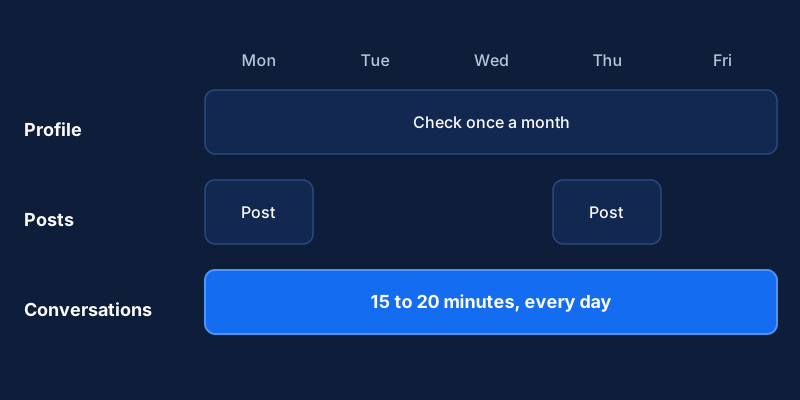
First, let us debunk the myth that you must post every single day. This is a common piece of advice that leads directly to burnout and, worse, a feed full of low-quality, rushed content. The goal is not to be the loudest voice in the room. It is to be the most thoughtful. For most B2B founders, the optimal cadence is two to four high-quality posts per week. Our analysis and data from other platforms suggest this is the benchmark for maximizing your reach without having new posts cannibalize the engagement of your previous ones. The algorithm needs time to distribute each piece. Give it that time.
The only way to maintain this cadence without it taking over your life is to use a content batching system. Dedicate a single two-hour block once a week to plan and write all your posts for the upcoming week. That is it. Find a quiet time, open a document, and focus solely on content creation. Research has shown that this type of task batching can reduce the time and mental energy spent on content creation by a significant margin, in some cases by up to 95% compared to daily creation. This removes the daily pressure and cognitive load of thinking "What should I post today?" It turns content from a chaotic daily task into a predictable, manageable process.
Next, I want to introduce a strategy I call the 'Comment-First' approach. Before you publish your own post for the day, spend 15 minutes leaving thoughtful, insightful comments on posts from other leaders and potential customers in your space. This is a critical warm-up exercise. It signals to the platform that you are an active, engaged community member, not just a broadcaster. The algorithm rewards this behavior. More importantly, it puts you and your expertise directly in front of relevant, engaged audiences. Executed correctly, a consistent commenting strategy can increase your profile views by 2-3x within just 30 days. Your comments become miniature billboards for your expertise.
Finally, you need to work smarter, not harder. This means embracing smart repurposing. You do not need to generate a new, brilliant idea for every single post. One core idea can be broken down and presented in multiple ways. For example, a 30-minute podcast interview you did contains enough material for a month’s worth of LinkedIn content.
- One key story can become a text-only post.
- A three-step framework you shared can become a carousel.
- A powerful quote can be a short video clip.
- A data point can be a simple text post with a bold claim.
This is about maximizing the impact of every idea without multiplying your effort. High-volume creators use a similar "content pyramid" model, where one large piece of "pillar" content (like a webinar or a keynote speech) is systematically broken down into dozens of smaller social media assets. You are already creating content in your daily work through sales calls, investor updates, and team meetings. Your job is to capture those ideas and repurpose them for a wider audience.
Engagement That Builds a Community, Not Just a Following
Let us be perfectly clear. A large following is a vanity metric. A highly engaged community is a strategic asset. The goal is not to collect connections. The goal is to build relationships. Your long-term success on LinkedIn will be determined not by the content you publish, but by the conversations you create. This entire process starts and ends in the comments section.
Most comments on LinkedIn are worthless. "Great post!" "Thanks for sharing." "Agree." These are engagement signals, but they do nothing to build a relationship or demonstrate your expertise. I teach my clients a simple framework for writing meaningful comments that spark real conversations. It is the A-A-Q method.
- Acknowledge: Start by acknowledging a specific point in the post that resonated with you. This shows you actually read and understood it.
- Add: Add your own unique perspective, a supporting data point, or a brief personal experience related to the point you acknowledged. This is where you provide value and showcase your expertise.
- Ask: End with a thoughtful, open-ended question to the author or the wider audience. This invites a reply and turns a monologue into a dialogue.
Comments that follow this structure are significantly more effective. The LinkedIn algorithm gives more weight to longer, more substantive comments (typically 10 words or more), pushing the original post and your comment to a wider audience.
Next, you must learn to use Direct Messages correctly. DMs are for relationship-building, not for cold pitching. The moment you connect with someone and immediately send them a generic, copy-pasted pitch about your product, you have destroyed any trust you might have built. The response rate for these unsolicited sales pitches is abysmal. Instead, think of DMs as a place for private, one-to-one conversations that extend the public discussion. Use them to thank someone for a comment, ask a follow-up question about their post, or reference a shared interest or mutual connection. The goal is a genuine conversation. The sale is a potential byproduct of that relationship, not the reason for it.
To focus your efforts, you need a targeted engagement strategy. I recommend a modified version of the 'Dream 100' strategy, a concept originally developed by the legendary sales coach Chet Holmes. Instead of identifying 100 dream customers, your goal is to identify 10-15 'key nodes' in your industry. These are not necessarily customers. They are the people and platforms that already have the attention of your ideal customers. These nodes can be:
- The top 5 influential people in your niche.
- The top 5 industry newsletters your customers read.
- The top 5 podcasts your customers listen to.
This is your Dream 15. Your job is to systematically and thoughtfully engage with their content every single day. Leave A-A-Q comments on their posts. Share their work with your network. Over time, you will build relationships with these key nodes, and they will begin to notice and amplify your work. You are borrowing their trust and reaching their audience by becoming a valued member of their community first.
Finally, you must be a gracious host. When people take the time to comment on your posts, you must reply to them. All of them. Especially in the first few hours after publishing. Our own internal data analysis of over 72,000 posts, supported by external research from companies like Buffer, shows that creators who reply to comments see about 30% higher engagement on average. This activity signals to the algorithm that your post is sparking a valuable conversation, and it will reward you with greater distribution. More importantly, it shows your audience that you are present, that you are listening, and that you value their contribution. This is how a following slowly, deliberately, and powerfully transforms into a community.
The Conversion Point: Guiding Followers to Become Customers
All this work, from building your brand to fostering a community, must eventually lead to revenue. But the conversion does not happen with a hard pitch. It happens subtly. It is the natural and inevitable result of the trust you have built. The world of B2B sales has fundamentally changed. Your buyers are more educated and more skeptical than ever before. Gartner research confirms that a full 80% of B2B buyers now prefer digital, self-service experiences over talking to a salesperson. They want to be educated, not pitched. Your LinkedIn strategy is the ultimate self-service education tool.
The first place this conversion begins is on your own profile. Your LinkedIn profile is not a resume. It is your personal sales page. You need to optimize it to guide visitors toward a desired action.
- Your Banner: This is prime real estate. Use a custom banner that clearly states who you help and what outcome you provide. Include a call to action or a visual of your product.
- Your Headline: Do not just list your job title. Your headline should be a value proposition. Use the formula: "I help [Ideal Customer Profile] achieve [Desired Outcome] through [Your Mechanism]."
- The Featured Section: This is your chance to showcase your best assets. Pin your most popular post, link to your company’s latest case study, or offer a direct link to subscribe to your newsletter or download a free resource.
A well-optimized profile turns passive profile viewers, who come from your posts and comments, into active leads for your business.
Within your content, you must master the 'Soft Call to Action'. A hard CTA is "Book a Demo" or "Buy Now." These are aggressive and only work on the tiny fraction of your audience who are ready to buy at that exact moment. A soft CTA is an invitation to receive more value, not to make a purchase. It is a lower-friction next step. Examples include:
- "I wrote a more detailed guide on this framework. Drop a comment if you'd like a copy."
- "We built a free tool to help with this exact problem. You can check it out here."
- "What's your take on this? Let me know in the comments."
The soft CTA respects the buyer's journey. It allows people who are in the early stages of awareness and consideration to engage further with your brand without feeling pressured. It keeps the conversation going and moves them deeper into your ecosystem.
The final piece of the puzzle is learning to identify and act on buying signals. A buying signal is a behavior that indicates a prospect is moving closer to a purchase decision. These signals are all over your LinkedIn activity, if you know where to look. When a prospect from a target account repeatedly likes your posts, that is a signal. When someone asks a specific, detailed question in the comments about a problem your product solves, that is a strong signal. When someone you have been engaging with visits your profile and your company's page, that is a very strong signal.
When you spot these signals, it is time to transition the conversation from public to private. Do not be aggressive. A simple, helpful approach works best. You can send a DM that says:
"Hey [Name], thanks for the thoughtful question on my post about [Topic]. It's a common challenge. I have a resource that walks through how we solve that for companies like yours. Would you be open to me sharing the link?"
Or:
"Hi [Name], I've really been enjoying your comments on my posts about [Topic]. I noticed you work at [Company], and we actually help a lot of similar businesses with [Problem]. No pressure at all, but I'm curious to learn if this is a priority for your team right now."
This approach is consultative, not pushy. You are connecting the dots between the value you have already provided and a potential solution. You have earned the right to ask. This is how the long game pays off. You build a brand, you create a community, and you guide the most engaged members of that community toward becoming customers, one trusted conversation at a time.
Related Content
The Ebook Distribution Playbook: Why Your Content ROI Fails (and How to Fix It)
Your high-quality ebook isn't generating leads? The problem is distribution. Learn the exact playbook top growth teams use to maximize content ROI.
Your Webinars Have a Vanity Metric Problem. Here's How I Fix It.
High webinar attendance doesn't equal revenue. As a marketing leader, stop chasing vanity metrics. I'll show you how to design a B2B webinar strategy that drives qualified leads and pipeline.
AI Content Production Pipeline
How to produce 10x more content without sacrificing quality using a systematic AI-assisted production workflow.