Build an AI-Assisted Content Workflow With Editorial Review
By Shuk Huay Koh, Founder, Mir Tech
Published Updated 6 min read
On this page
A model will draft 1,500 words in a minute and state invented details in the same confident tone as true ones. The workflow below is built around that fact. AI handles the blank page: outlines, first drafts, reformatting, summaries. People handle what carries your name, which is the point of view, the facts and the decision to publish.
This is the kind of system we set up under Repeatable Workflows, and you can build it with tools you already use.
The gates
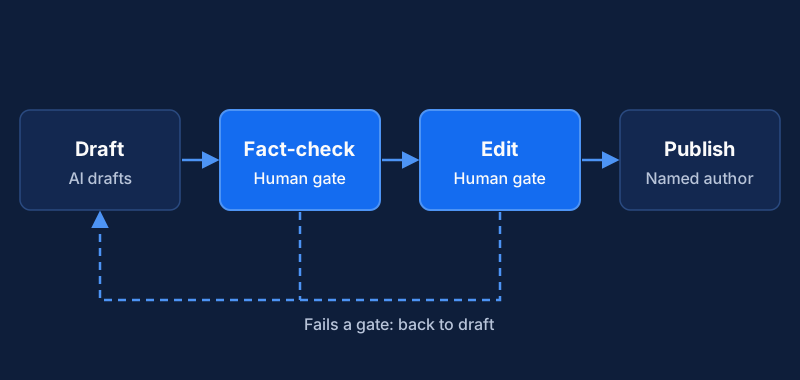
Only the first stage is automated. Nothing moves to the next without a person signing the gate. That one rule prevents the usual failure, where everyone assumes someone else checked the facts. Write the split down:
| Task | AI does | A person does |
|---|---|---|
| Topic selection | Clusters questions and search terms | Chooses what fits the strategy |
| Brief | Suggests an outline | Sets the angle, reader and sources |
| First draft | Writes from the brief | Marks it unreviewed |
| Facts and claims | Nothing | Verifies every one |
| Original insight | Nothing | Adds examples, opinions, data |
| Voice and edit | Flags deviations | Rewrites and approves |
| Repurposing | Drafts variants | Approves before posting |
You need four things in place first, or AI will only speed up the production of average content. One clear message, because drafts from a vague message are generic. A named owner for quality, usually an editor or the founder, who has the right to reject a draft. Access to real expertise such as interview notes, call recordings, support tickets and internal documents. And a spreadsheet or board with a status column to track work.
1. Write the editorial standard
Create one short document that every brief and review refers to. It covers the audience (who reads, what they know, what they need to decide) and the voice, with three or four traits and a good and a bad example of each, since "plain" means little without a sample sentence. It lists which sources count (original research, vendor documentation, your own data) and which do not (another blog's summary of a statistic). It names banned moves: invented customer stories, unsourced statistics, claims about results you cannot prove and filler openings. Decide once whether and how you say AI helped.
Paste six to ten of your best existing pieces into the document as reference. Models imitate examples better than they follow adjectives.
2. Plan topics and write a brief
Pick topics from evidence. Good inputs are questions prospects ask on sales calls, objections that stall deals and search queries you already get impressions for. The customer research guide covers how to collect them. Then write a one-page brief per piece:
Working title:
Reader (role, situation):
The question they are asking:
Our point of view in one sentence:
What we can say from first-hand experience:
Sources to use (links or documents):
Claims we must not make:
Related pages to link:
Call to action:
Length and format:
The first-hand line matters most. If it is empty, you do not have a piece yet, so go and talk to someone.
3. Draft in stages with AI
Do not ask for a finished article in one prompt. Start with an outline from the brief, and edit it yourself, because that is the cheapest place to fix a weak argument. Then draft one section at a time, passing in the relevant source material and telling the model to mark any claim it cannot support from that material. Ask for transitions and a consistent order at the end. Finish with a flag pass: ask the model to list every number, name, date and comparison in the draft. That list becomes the review checklist.
A flag list is short and mechanical. Each line holds one checkable item and a place for the reviewer to record the source:
Claim: "Attendance averages one third of registrations"
Type: number
Source link:
Checked by / date:
Verdict: confirmed | reworded | cut
Keep every draft in a state called "unreviewed" until someone signs it off, so a draft cannot reach the site by accident.
Never ask the model to "include statistics" or "add expert quotes". It will produce plausible ones. If a number belongs in the piece, a person finds the source and hands it over.
4. Run human editorial review
This step makes the workflow trustworthy, and it has two passes because the skills differ.
The expert checks whether each statement is correct for your market today and what is missing that only experience would supply. They add one real example, an honest limitation or a trade-off, because model drafts read as if every option works equally well.
Time-box both passes. A reviewer with an open-ended task skims, and one with a flag list and thirty minutes checks every line. If a draft needs more than a light rewrite to pass, send it back to stage 3 with notes on what was missing, and fix the brief so the next draft starts better. Do not repair a weak draft by hand a second time.
The editor works down the flag list. Open each link and confirm the page states the number. Remove anything unsupported, keeping the point and dropping the figure if you must. Check voice against the standard, cut padding and confirm a named author can answer for the piece.
Google's guidance bears on this. It says that using automation, including AI, to generate content mainly to manipulate search rankings is spam, and it asks creators to consider the "who, how and why" behind content. A named author, a clear reason for the page and honest sourcing satisfy both ideas, and they are good practice regardless of search.
5. Publish and distribute
Publish only reviewed pages. Keep the source log, meaning the flag list with its verdicts, next to the page in your tracker, so that anyone who questions a claim later can see where it came from.
On the page itself, show the author, the publication date and the date of the last update, and link to sources in the text. Plan distribution before you publish, because a piece with no plan is read by people who already follow you. The content distribution playbook covers the channels and cadence. AI can draft channel-specific variants, and a person approves each one. Add the page to the newsletter queue and relevant sales sequences, link to it from older pages and give the author a short note to post in their own voice.
6. Measure and update
Pick one outcome per piece before you write it: qualified conversations started, newsletter signups from the page, or a salesperson asking for the link. Traffic alone tells you little.
Review monthly what shipped and what each piece achieved. Each quarter, update the oldest pages with new sources and examples, merge pages that compete and retire pages that no longer fit. After every review, add what you learned to the standard. If editors fixed the same problem three times, change the brief or the prompt.
When something breaks, the cause is usually upstream of the symptom. Posts that sound like everyone else's mean the brief had no first-hand material. An untraceable statistic means the model supplied it, so cut it or find the original. Editors who rewrite everything point to a vague voice standard, and a backed-up review queue means too many pieces for one expert. Pages that publish unreviewed mean there is no status gate, so make "reviewed" a required field.
Publish less
It is tempting to measure this workflow by pieces published. Resist that. The real gain is that experts spend their time on judgment instead of typing. Our view is that a team publishing a little less, with sharper opinions and clean sourcing, builds more trust than one that fills the blog. Run one content type, such as a how-to article, through all six steps for a month. Fix the friction, then add a second type.
Implementation steps
- Write the editorial standardDocument your voice, your audience, your source rules and the claims you will never publish without evidence. This file is the input to every brief and every review.
- Plan topics and write a briefChoose topics from customer questions and search demand, then write a one-page brief with the reader, the point of view, the sources and the call to action.
- Draft in stages with AIUse AI for outlines, a first draft of each section and a repurposing pass. Give it your brief and your sources, and keep the draft marked as unreviewed.
- Run human editorial reviewA subject matter expert checks facts and adds first-hand detail. An editor checks voice, structure and every claim against its source.
- Publish and distributePublish with a named author, a date and sources. Turn the piece into channel-specific posts and email, and link it into the pages that already exist.
- Measure and updateReview each piece on a fixed schedule against one business outcome. Update, merge or retire pages, and feed what you learn back into the editorial standard.
Related Content
Personalize Website and Email Content by Segment
A practical guide for B2B teams to personalize web and email content by segment: plan variants, add fallbacks and test against a control group.
Content Distribution Playbook: One Core Piece, Many Channels
How small B2B teams can turn one strong piece of content into posts, emails, talks and sales assets, with a distribution plan you can run weekly.
Gated or Ungated? A Distribution Plan for Your Ebook
How to decide whether to gate a B2B ebook, and a step-by-step distribution and follow-up plan so the asset reaches buyers instead of sitting on a server.