Proposal to Signature: How to Close Deals Faster
By Andrew Mark, Co-founder, Mir Tech
Published Updated 6 min read
On this page
Forrester's research found that 86% of B2B purchases stall during the buying process, and the same research reports about 13 people taking part in a typical buying decision. Read those two numbers together. Your proposal does not land on one person. It lands on a group where everyone needs to be comfortable, inside an internal process you may never have seen.
That explains why a deal can look certain until the proposal goes out, and then go quiet. The buyer says they liked it, then replies slowly or not at all. A cleverer follow-up email rarely fixes this. What helps is a path from proposal to signature that is explicit, shared and started earlier than most teams start it.
To find out where your own deals slow down first, use pipeline velocity.
What must be true before you send
Most proposal-stage stalls trace back to something missing earlier. Before you send anything, check five points.
The problem should be in the buyer's words. If they have not said or written it, you are guessing. The budget range should be known. You do not need an exact figure, only confidence that the price is not a surprise. The approver should be named, and it may not be your champion, so ask directly who signs an agreement like this and how they usually decide. The buying group should be mapped: know who else reviews the proposal, such as finance, IT or a user team, and record the roles as CRM fields so the information outlives one rep's memory. Last, a date should be agreed. Ask what happens if they do nothing, and when they would like to start. A real start date creates a deadline you did not have to invent.
We would advise against the usual substitute, an end-of-quarter discount with an artificial deadline. Buyers recognize it, and it moves the conversation to price. A genuine start date does the same job without the cost.
Gong's analysis of sales conversations found that closed-won deals include 67% more contacts than closed-lost deals. The data is correlational, but the practical lesson holds. If your only contact leaves, goes on vacation or loses interest, a single-threaded deal stops. Meet at least one more person on the buyer's side before the proposal goes out.
Present the proposal instead of only sending it. Book 30 minutes to walk through it, check the problem statement, scope and price, and ask who else needs to see it. A concern you hear live costs you a minute. The same concern found two weeks later costs you the deal. Send the document after the call, with a short summary of what you agreed and the next step.
The mutual action plan
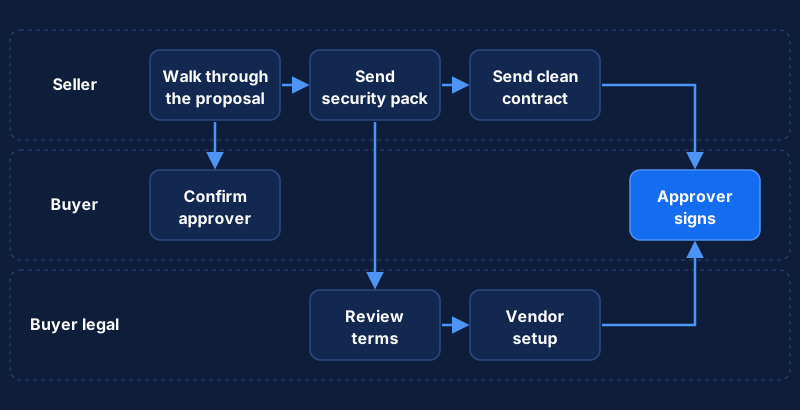
A mutual action plan, or MAP, is a shared list of steps from proposal to the start of work, each with an owner and a date. It is the most useful late-stage document, because it replaces "let me know your thoughts" with a plan the buyer helped write.
| Step | Owner | Target date | Status |
|---|---|---|---|
| Walk through proposal with the buying group | Seller and buyer | ||
| Security or vendor questionnaire returned | Seller | ||
| Legal review of agreement | Buyer legal | ||
| Procurement setup | Buyer procurement | ||
| Approver signs | Buyer approver | ||
| Kick-off call | Both |
Build it with the buyer, not for them. Start from the date they want to begin and work backwards. If the date is impossible, the plan shows why, and you can discuss it openly.
Share it as a live document or spreadsheet link and not as a PDF. Review it in every call, because two minutes at the start is enough. When a date slips, ask what changed. A slipped date is information and not a failure.
A MAP also surfaces steps buyers often hide. A champion may say "we will sign next week" without mentioning that procurement needs a vendor form and legal needs ten days. Written down, those steps come into view while you can still act.
Legal and procurement: start in discovery
Legal and procurement reviews are the most common source of late delay, and the easiest to prepare for. Add three questions to your discovery call. Who reviews contracts for a purchase like this? Do you need documents from us, such as a security questionnaire, an insurance certificate or company registration? How long does that review usually take? The answers go straight into the MAP. If the review takes weeks, start it as soon as the proposal is verbally accepted, in parallel with everything else.
Then reduce what there is to review. World Commerce & Contracting's research says that the average business loses almost 9% of value annually through poor contract management. That figure covers the whole contract lifecycle and reaches beyond sales, but it shows why contract basics matter. For a small team the practical steps are modest:
- Keep your standard agreement short and readable. Fewer clauses mean fewer redlines.
- Decide fallback positions in advance for the three clauses buyers change most, such as liability, payment terms and data protection. Write the position you will accept and who can approve it.
- Keep a pack of standard documents ready: a company profile, a security overview, data protection terms and payment details.
- Name one person on your side who owns the contract. In a founder-led team that is often the founder. Say so, so the buyer's lawyer knows who to email.
If the same clause causes trouble in several deals, change the template instead of renegotiating each time.
Your champion can often move a stalled review. Give them a short note to forward: what the agreement covers, the main terms and what you need from legal. It is easier for them to ask "can you review this by Friday" than to explain a contract they did not write.
Making signature easy
Once terms are agreed, the remaining delay is friction, so remove it.
Use e-signature. A signing link works on a phone and needs no printer. In the United States, federal law says a signature or contract may not be denied legal effect solely because it is in electronic form. Other countries have their own rules, and some document types have special requirements, so check the law that applies to your contract.
Send a clean document with every field filled: names, dates and amounts. A contract with blanks invites questions. Set the signing order, and if two people sign on the buyer's side, say who goes first. If the approver is traveling, ask when they will have ten minutes.
Brief the approver if they were not part of the sale. A three-line summary does it: what they are buying, why, and what it costs. Your champion can add context. An approver who has not seen the reason for the purchase will often delay it. Finally, say what happens next. Include the kick-off date and who will be in touch, because a buyer who can see the start of the work finds it easier to sign.
When the champion goes quiet, widen the thread before you chase harder. Write to the approver with the three-line summary and an offer to answer questions, and copy the champion so nobody is bypassed. Then send one short note that closes the loop: you will hold the proposed start date until a named day, and after that you will assume priorities have moved. Silence from a champion is often a sign that their own approval path has stalled, and an open offer of help gives them a reason to reply.
A weekly check on late-stage deals
You do not need analytics to see trouble early. Once a week, ask four questions about each late-stage deal:
- Has a MAP step slipped, and does the buyer know why?
- Have we spoken to anyone other than the champion in the last two weeks?
- Is there a dated next step with an owner?
- Does the approver know about the deal?
If two answers are "no", call the champion, ask what changed and offer to adjust the plan. Be direct: "Is this still a priority this quarter?" is a fair question. A clear "no" beats months of silence, and it keeps your forecast honest.
The steps that work belong in your sales playbook so they repeat, which is the idea behind execution playbooks. To learn why a lost deal was lost, use win/loss analysis.
If you change one thing this week, add the three legal and procurement questions to discovery, and write the answers into a MAP.
Frequently asked questions
What is a mutual action plan?
A mutual action plan is a shared document that lists the steps between now and signature, who owns each step and the target date. Buyer and seller both edit it. It makes the buyer's internal steps, such as security review and procurement, visible early.
When should I send the proposal?
Send it when the buyer has confirmed the problem, the budget range and who approves the purchase. Sending earlier tends to produce a proposal that sits unread. A short call to walk through it is better than an email alone.
How do I deal with procurement and legal reviews?
Ask about them in discovery, not after the proposal. Find out who reviews contracts, what documents they need and how long it usually takes. Send security and company documents early, and keep your standard terms short so there is less to redline.
Are electronic signatures legally valid?
In many jurisdictions, yes. In the United States, federal law says a signature or contract cannot be denied legal effect solely because it is electronic. Rules differ by country and by document type, so check the law that applies to your contract, and ask a lawyer for anything unusual.
Related Content
Personalize Website and Email Content by Segment
A practical guide for B2B teams to personalize web and email content by segment: plan variants, add fallbacks and test against a control group.
Sales to Customer Success Handoff: Workflow and Data
A practical guide for small B2B teams to hand a closed deal from sales to customer success with a clear trigger, shared data and a checklist.
Build an AI-Assisted Content Workflow With Editorial Review
A step-by-step guide for B2B teams to set up an AI-assisted content workflow where every draft passes human editorial review before it publishes.