How AI is Transforming B2B Outreach in 2026
The Old Way is Broken
Traditional B2B outreach relies on manual prospecting, generic templates, and spray-and-pray tactics. An SDR spends three hours researching prospects, another hour writing semi-personalized emails, sends a batch of 50, and gets two replies — one of which is "please remove me from your list."
The result? Low reply rates, burned domains, frustrated sales teams, and a cost-per-meeting that makes paid advertising look cheap.
The numbers tell the story. The average cold email reply rate in traditional outreach sits at 1-3%. The average SDR books 8-12 meetings per month. The average ramp time for a new SDR is 3-4 months before they hit quota. And the average annual cost — salary, tools, management overhead — runs $85,000-120,000 per SDR.
That math only works if every other channel is more expensive. In 2026, it no longer is — if you're still doing outreach the old way.
The AI Outreach Revolution
AI hasn't just improved B2B outreach incrementally. It has fundamentally restructured what's possible. Tasks that used to take hours now take seconds. Personalization that was humanly impossible at scale — referencing a prospect's specific situation, recent activity, company context, and industry challenges — is now automated.
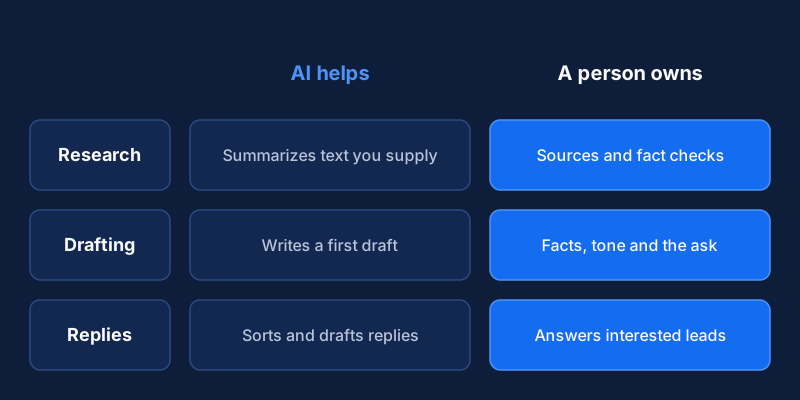
But this isn't about replacing humans with robots. The teams winning with AI outreach are using it to make their people dramatically more effective: better targeting, sharper messaging, faster iteration, and more time spent on the high-value work of actually having conversations with qualified prospects.
Here's how the AI outreach stack works in practice.
The AI Tool Landscape for B2B Outreach
The AI outreach ecosystem has matured into distinct categories, each addressing a specific part of the outreach workflow. Understanding these categories helps you build a stack that covers the full pipeline without redundancy.
Category 1: Data Intelligence and Enrichment
These tools aggregate and analyze data about companies and individuals to build rich prospect profiles.
What they do:
- Pull firmographic data (company size, revenue, funding, industry, tech stack)
- Surface contact information (verified email, phone, LinkedIn profile)
- Track company signals (hiring surges, product launches, funding rounds, leadership changes)
- Map organizational structure (reporting lines, decision-making hierarchy)
Why they matter for AI outreach: The quality of your personalization is directly limited by the quality of your data. AI can't write a compelling email about a prospect's recent funding round if your data layer doesn't capture funding events. The enrichment layer is the foundation everything else builds on.
What to evaluate: Coverage (what percentage of your target accounts have complete data), accuracy (how often is the data correct and current), freshness (how frequently is the data updated), and depth (how many data points per contact).
Category 2: Intent Signal Platforms
These tools identify which companies and individuals are actively researching topics related to your solution.
What they track:
- Website visitor identification (which companies are visiting your site, which pages, how often)
- Content consumption signals (who is reading articles, attending webinars, or downloading resources related to your category)
- Job posting analysis (companies hiring for roles that indicate they're building the function your product supports)
- Technology adoption signals (companies adding or removing tools in your competitive landscape)
- Social engagement signals (prospects engaging with content about topics you solve)
Why they matter: Intent data transforms cold outreach into warm outreach. When you know a company is actively researching solutions like yours, your email lands differently. The prospect is already thinking about the problem — you're just showing up at the right time.
Category 3: AI Writing and Personalization Engines
These tools generate personalized outreach copy at scale using prospect data and configurable writing frameworks.
What they do:
- Take structured prospect data (from your enrichment layer) as input
- Apply writing frameworks and templates you define
- Generate unique, personalized emails for each prospect
- Produce multiple variants for A/B testing
- Adapt tone and approach based on prospect seniority, industry, and persona
The personalization spectrum:
At the basic end, these tools do variable insertion — dropping a company name and job title into a template. This is table stakes and doesn't meaningfully improve performance.
At the advanced end, they synthesize multiple data sources into genuinely unique messages. A well-configured AI writing engine might produce an email that references the prospect's company recently expanding into a new market, connects that to a challenge typically faced during that expansion, and positions your solution in context — all without a human writing a word.
The gap between basic and advanced is where the competitive advantage lives.
Category 4: Sequencing and Orchestration Platforms
These tools manage the multi-step, multi-channel execution of outreach campaigns.
What they handle:
- Email sequence execution (automated follow-ups on a defined cadence)
- Multi-channel coordination (email, LinkedIn, phone — in a unified workflow)
- Send scheduling (optimal timing based on timezone, day of week, and historical engagement data)
- Reply detection and sequence pausing (automatically stop the sequence when a prospect responds)
- A/B testing infrastructure (split test subject lines, copy, CTAs, send times at scale)
Category 5: Analytics and Optimization Engines
These tools measure, analyze, and improve campaign performance through machine learning.
What they provide:
- Real-time dashboards with per-campaign, per-inbox, and per-message analytics
- Automatic winner detection in A/B tests
- Send time optimization (learning when each prospect is most likely to engage)
- Copy scoring (predicting which messages will perform best before sending)
- Funnel analytics (tracking from send to reply to meeting to opportunity to revenue)
Personalization at Scale
Personalization is the single biggest lever in outreach performance. The difference between a generic email and a truly personalized one isn't marginal — it's typically a 2-4x improvement in reply rates.
But real personalization at scale requires more than inserting {{first_name}} and {{company_name}}. Here's how AI enables genuine personalization across thousands of prospects.
Data Source Layering
Effective personalization pulls from multiple data sources simultaneously:
Layer 1: Firmographic data. Company size, industry, revenue, location, and growth stage. This is the baseline — it tells you what type of company you're writing to.
Layer 2: Technographic data. What tools, platforms, and technologies the company uses. This reveals their current workflow and potential gaps your solution fills.
Layer 3: Trigger events. Recent funding, leadership changes, product launches, office expansions, or acquisitions. Trigger events create natural conversation openings because they introduce new challenges.
Layer 4: Intent signals. Website visits, content downloads, search behavior, and social engagement that indicate active interest in your category.
Layer 5: Personal context. The individual prospect's LinkedIn activity, published content, job tenure, career history, and public statements. This is the most powerful personalization layer because it makes the email feel like it was written specifically for them.
Multi-Variable Personalization
The most effective AI outreach systems don't just personalize one element — they personalize multiple elements simultaneously, creating a combinatorial effect:
- Subject line personalized to the prospect's role and a recent trigger event
- Opening line referencing something specific to the individual (their LinkedIn post, a company announcement, a shared connection)
- Pain point tailored to their company's stage, industry, and current tech stack
- Social proof matched to their industry and company size (a case study from a similar company)
- CTA calibrated to their seniority level (executives prefer "worth a conversation?" while managers prefer "want to see a quick demo?")
Each variable multiplied across the others creates thousands of unique email combinations from a single campaign template. The AI handles the synthesis — your team handles the strategy.
Prompt Engineering for Outreach
The quality of AI-generated outreach depends heavily on how you instruct the AI. This is prompt engineering applied to sales, and it's a skill that separates mediocre AI outreach from exceptional results.
Key principles:
Be specific about tone. "Write a professional email" produces generic output. "Write a casual, direct email in the tone of a peer who genuinely wants to help — no corporate jargon, no buzzwords, 3rd-grade reading level" produces something a human would actually respond to.
Provide examples of what good looks like. Include 3-5 examples of high-performing emails in your prompt. The AI will pattern-match on structure, tone, and approach.
Define what to avoid. Explicitly list phrases, patterns, and approaches that should never appear: no "I hope this email finds you well," no "touching base," no "synergy," no "reach out" (use specific verbs instead).
Constrain length. Set hard word count limits. AI tends to be verbose. The best cold emails are 50-100 words. Set that as a constraint.
Separate research from writing. Use one prompt to analyze the prospect data and identify the most relevant personalization angle. Use a second prompt to write the email based on that analysis. Two-step prompting consistently outperforms single-step.
Campaign Architecture
A single email is not a campaign. Modern AI-powered outreach operates through carefully designed multi-channel sequences that adapt based on prospect behavior.
Multi-Channel Sequence Design
The highest-performing outreach sequences in 2026 combine email, LinkedIn, and occasionally phone into a unified flow:
Day 1: Email 1 — Personalized cold email with observation + value proposition + soft CTA.
Day 2: LinkedIn connection request — Short, personalized note referencing the same topic as the email but from a different angle.
Day 4: Email 2 — Follow-up that adds new information (case study, data point, relevant insight). Not a "just checking in" bump.
Day 7: LinkedIn engagement — Comment thoughtfully on the prospect's recent post or share a resource relevant to their stated interests.
Day 9: Email 3 — Different angle entirely. If Email 1 led with a pain point, Email 3 leads with a result or case study.
Day 14: Email 4 — The breakup email. Short, direct, low-pressure. "Seems like the timing isn't right. If [pain point] becomes a priority, happy to revisit."
Day 21: LinkedIn message — Soft touch. Share something genuinely valuable (an article, a benchmark, a tool) with no ask attached.
Timing Optimization
When you send matters almost as much as what you send:
- Tuesday through Thursday consistently outperform Monday and Friday for B2B cold email
- 8-10 AM in the prospect's timezone catches them during the morning email review
- Late afternoon (4-5 PM) is a secondary peak as people clear their inbox before end of day
- Avoid sending at exactly the hour or half-hour (9:00, 9:30) — schedule for odd times (9:07, 9:23) to avoid the batch-send look
AI-powered send time optimization goes further by learning each prospect's engagement patterns. If a prospect consistently opens emails at 7 AM, the system learns to send to them at 6:55 AM.
Follow-Up Cadence Principles
Most responses come from follow-ups, not the initial email. Data across millions of outreach emails shows:
- Follow-up 1 generates 30-40% of total replies
- Follow-up 2 generates 20-25% of total replies
- Follow-up 3 generates 10-15% of total replies
- Beyond Follow-up 3, response rates drop below 5% and spam risk increases
The key to effective follow-ups: never send a "just following up" email. Every touch must add new value, a new angle, or new information. If you can't think of something new to say, the sequence should end.
Integration Workflows
AI outreach doesn't exist in isolation. Its power multiplies when connected to your broader revenue stack.
CRM Synchronization
Every outreach interaction — sends, opens, replies, meetings booked — should flow into your CRM automatically. This creates:
- Complete prospect timeline — Sales reps see every touchpoint before a call
- Attribution data — Marketing can measure which campaigns and messages drive revenue
- Duplicate prevention — Avoid embarrassing situations where multiple team members contact the same prospect
- Stage management — Automatically move prospects through pipeline stages based on engagement (replied, meeting booked, opportunity created)
Data Enrichment Pipelines
Your outreach system should continuously enrich prospect data:
- When a new lead enters your CRM, automatic enrichment fills in missing firmographic and contact data
- Ongoing enrichment updates existing records when companies raise funding, change leadership, or show new intent signals
- Enriched data feeds back into the AI personalization layer, making future outreach more targeted
Intent Signal Integration
Connect your intent data sources to your outreach orchestration:
- When a target account visits your pricing page, automatically trigger a personalized email sequence
- When a prospect engages with competitor content, add them to a competitive positioning campaign
- When a company posts a job listing for a role your product supports, initiate a sequence highlighting how your solution reduces the need for that hire or accelerates the new hire's ramp
These automated triggers ensure your outreach arrives when the prospect is most receptive — when the problem you solve is already top of mind.
Results Benchmarks
AI-powered outreach systems consistently outperform traditional methods across every metric that matters. Here's what well-implemented systems deliver:
Email Performance
| Metric | Traditional Outreach | AI-Powered Outreach | Improvement |
|---|---|---|---|
| Open Rate | 25-35% | 55-70% | 2x |
| Reply Rate | 1-3% | 5-12% | 3-4x |
| Positive Reply Rate | 0.5-1% | 3-6% | 4-6x |
| Bounce Rate | 5-8% | 1-3% | 60% reduction |
| Meeting Book Rate | 0.3-0.5% | 1.5-3% | 4-5x |
Operational Efficiency
| Metric | Traditional | AI-Powered | Impact |
|---|---|---|---|
| Time to build a 1,000 prospect list | 15-20 hours | 1-2 hours | 90% reduction |
| Time to personalize 100 emails | 8-10 hours | 15-30 minutes | 95% reduction |
| Meetings booked per month (per rep) | 8-12 | 25-40 | 3x |
| Cost per qualified meeting | $500-800 | $150-250 | 70% reduction |
| SDR ramp time to quota | 3-4 months | 2-4 weeks | 75% reduction |
Pipeline Impact
Teams running AI-powered outreach systems typically see:
- 30-50 qualified meetings per month per outreach system (not per rep — the system runs semi-autonomously)
- 40-60% reduction in customer acquisition cost compared to traditional outbound
- Pipeline generated within 30 days of system launch (vs. 90+ days for traditional SDR ramp)
- Consistent month-over-month improvement as the AI optimizes messaging, timing, and targeting based on accumulated performance data
These benchmarks assume proper infrastructure (authenticated domains, warmed inboxes, clean data) and well-crafted messaging frameworks. The AI amplifies good strategy — it doesn't replace it.
Common Pitfalls and How to Avoid Them
Pitfall 1: Over-Automation Without Oversight
AI can generate and send thousands of emails. That doesn't mean it should. Without human oversight on messaging quality, targeting accuracy, and brand alignment, you risk sending emails that damage your reputation.
The fix: Human review gates at two points — message template approval before campaigns launch, and weekly quality spot-checks on personalization output. Automate execution, not strategy.
Pitfall 2: Ignoring Deliverability Fundamentals
The most sophisticated AI personalization in the world is worthless if your emails land in spam. Many teams invest heavily in AI tools while neglecting domain infrastructure, warmup, and list hygiene.
The fix: Build the deliverability foundation first, then layer on AI. See our complete cold email deliverability guide for the full infrastructure setup.
Pitfall 3: Treating AI Output as Final
AI generates drafts, not finished products. The best-performing teams use AI to produce a strong first draft that a human then refines — adjusting tone, catching inaccuracies, and adding nuance that AI misses.
The fix: Build a review step into every workflow. The time savings come from AI handling 80% of the work, not 100%.
Pitfall 4: No Feedback Loop
If your AI system sends emails but doesn't learn from the results, you're leaving the biggest advantage of AI on the table. The compounding improvement from continuous optimization is what makes AI outreach a widening moat, not just a one-time efficiency gain.
The fix: Connect reply data, meeting data, and deal data back to your AI layer. Which personalization angles generate the most replies? Which subject line patterns drive the highest open rates? Feed this data back into your prompts and templates monthly.
Pitfall 5: Scaling Before Validating
The temptation with AI outreach is to scale immediately — "if we can send 100 personalized emails, why not 10,000?" Scaling before you've validated your messaging, targeting, and infrastructure just means you'll burn domains and waste data at 100x the rate.
The fix: Start with 50-100 emails per day across 2-3 inboxes. Validate metrics over 2-3 weeks. Only scale once you're consistently hitting benchmark performance numbers.
Building Your AI Outreach Stack
Here's the practical implementation path, from zero to a fully operational AI outreach system:
Week 1: Infrastructure. Set up sending domains, configure DNS authentication (SPF, DKIM, DMARC), create email inboxes, and begin warmup. See our email warmup system for the detailed process.
Week 2-3: Data foundation. Build your initial prospect list using enrichment tools. Define your Ideal Customer Profile (ICP) with specific firmographic, technographic, and behavioral criteria. Verify all email addresses.
Week 4: Messaging framework. Develop 2-3 email template frameworks. Write the AI prompts that will generate personalization. Draft your multi-channel sequence. Have a human write the first 50 emails to establish a performance baseline.
Week 5-6: Launch and test. Begin sending AI-personalized emails at low volume (50-100/day). A/B test aggressively — subject lines, opening lines, CTAs, send times. Monitor deliverability metrics daily.
Week 7-8: Optimize and scale. Analyze results. Double down on what's working. Kill what isn't. Increase volume gradually as metrics hold. Add new sequences for different ICPs or use cases.
Week 9+: Compound. The system improves itself through continuous learning. Monthly optimization cycles refine targeting, messaging, and timing. Each month outperforms the last.
The Future of B2B Outreach
The future of B2B outreach isn't about sending more emails. It's about sending smarter ones — messages that arrive at the right time, say the right thing, and feel like they were written by someone who genuinely understands the recipient's situation.
AI makes this possible at a scale that was unimaginable even two years ago. But the teams that win aren't the ones with the most sophisticated AI — they're the ones who combine strong AI capabilities with smart strategy, rigorous infrastructure, and disciplined execution.
The gap between AI-powered teams and traditional outbound is widening every quarter. The cost of waiting isn't staying the same — it's compounding.
For a full implementation of AI-powered outreach tailored to your B2B team, explore our email and LinkedIn outreach systems or start with the foundational email warmup system to get your infrastructure right from day one.
Related Content
AI Content Production Pipeline
How to produce 10x more content without sacrificing quality using a systematic AI-assisted production workflow.
LinkedIn Automation & Engagement System
A complete system for automating LinkedIn outreach while maintaining authentic engagement and avoiding account restrictions.